Spray Foam Insulation Salisbury MA - Quick Facts
Local energy code in Salisbury
- Salisbury is a Stretch Code community - the statewide baseline for new construction and major renovations. IECC Climate Zone 5A.
- Massachusetts has three energy-code levels - base (2021 IECC), Stretch, and Specialized (Opt-In) - and Salisbury is on the Stretch Code.
Insulation & air sealing in Salisbury
- Spray foam is one of the fastest ways to hit the 3.0 ACH50 blower door target and the HERS 42/45 scores required in Salisbury.
- Envelope R-values follow IECC Climate Zone 5A (roughly R-49 to R-60 attic and R-20+ walls).
- Open-cell and closed-cell assemblies are evaluated during HERS plan review; as RESNET raters, not an insulation contractor, we give unbiased guidance on where R-value and air-sealing dollars move your score most.
Mass Save rebates for Salisbury (2026)
- Better air sealing and insulation move projects into higher Mass Save tiers - up to $25,000 for a new all-electric single-family home and up to $30,000 (Level 2) for all-electric renovations - verified by a RESNET-certified HERS rater.
RESNET-certified · 15,000+ ratings completed · 5.0 stars across 136 Google reviews · (617) 501-6788
Spray Foam Insulation Installer in Salisbury, MA
Salisbury sits in IECC Climate Zone 5A, so a well-insulated, air-sealed home is essential for comfort and cost. We install spray foam insulation on a mix of colonials, capes, ranches, and newer construction.
We Install Spray Foam in Salisbury
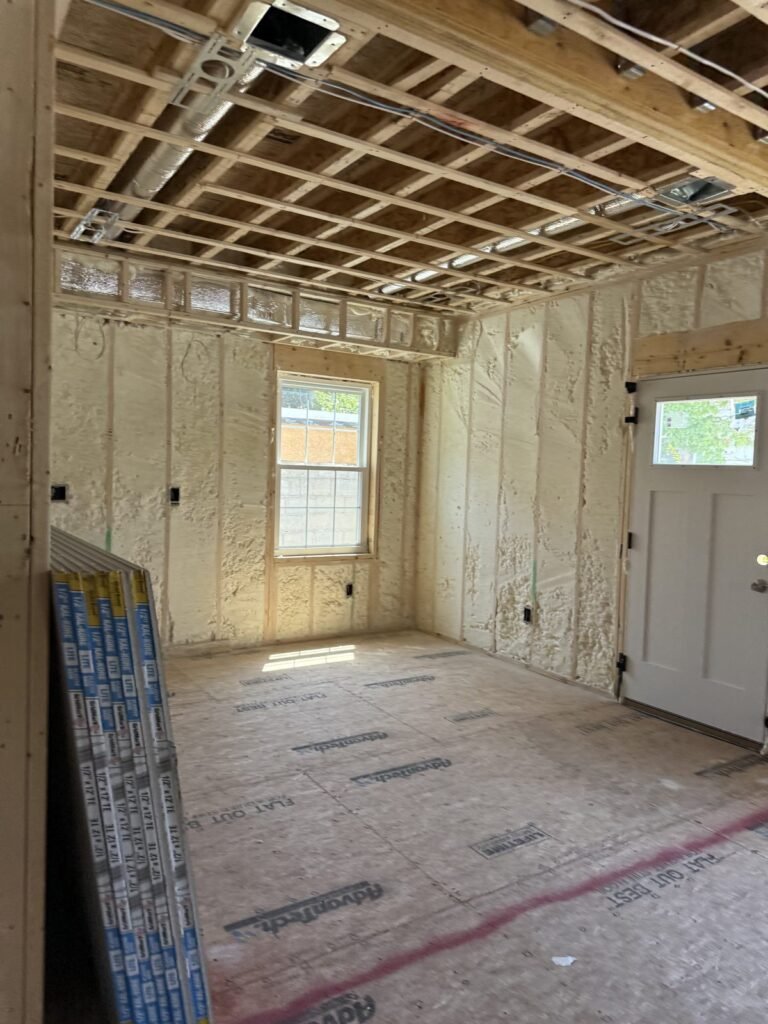
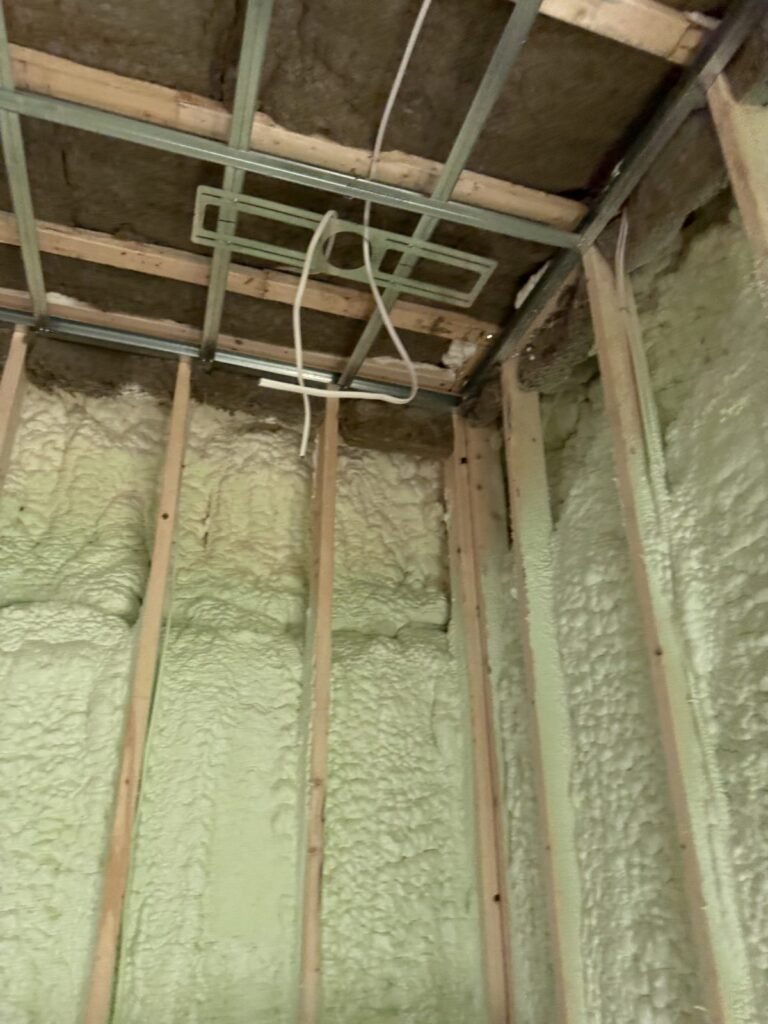
Home Energy Efficiency Consultants installs spray foam insulation for Salisbury homeowners, builders and contractors. We are also certified HERS raters, so the same company that installs your foam can run the blower door test and the HERS rating your permit may need.
- Where we install it: attics and roof lines, rim joists, exterior walls, kneewalls, basements and crawl spaces.
- How a job runs: we look at the house, give you a written scope and price, install the foam, then test the results.
- Why one team helps: the people who sealed the house are the people who test it, so air leaks found on the blower door test get fixed before the final rating.
Our Everett office at 371 Main St, Everett serves Salisbury. Request a spray foam quote or call 617-501-6788.
Open-Cell vs. Closed-Cell Spray Foam
Spray foam comes in two families, and the right choice shapes both performance and cost on a Salisbury project.
Closed-Cell Spray Foam
Dense and rigid at roughly R-6 to R-7 per inch — the highest R-value of common insulation. It also acts as an air and vapor barrier and adds stiffness, making it ideal for rim joists, basements, crawlspaces, and roof decks in Salisbury homes.
Open-Cell Spray Foam
Lighter and vapor-permeable at about R-3.5 to R-3.8 per inch. It expands to fill irregular cavities, seals air leaks, and dampens sound — a strong choice for interior walls and attics where drying potential matters.
How Insulation Materials Compare
R-value measures resistance to heat flow — higher is better. Here is how the insulation materials used on Salisbury, Salisbury projects compare per inch of thickness.
Wood fiber
Renewable, carbon-storing batts and boards with strong sound dampening and vapor-open performance.
Polyiso rigid board
The highest-R rigid foam board; foil-faced and used for continuous exterior insulation to stop thermal bridging.
Fiberglass batts
The most common and economical insulation; must be cut and fitted carefully because gaps and compression sharply reduce real-world performance.
Open-cell spray foam
Lighter and vapor-permeable; expands fully to fill irregular cavities, seals air leaks and dampens sound. A common choice for interior walls and vented attics.
EPS rigid board
Expanded polystyrene; the most affordable rigid foam, used for continuous exterior and below-grade insulation.
Cellulose (dense-pack)
Recycled paper fiber treated for fire and pests; dense-packs into closed wall cavities, making it ideal for retrofits.
Fiberglass blown-in
Loose-fill for open attic floors; fast to install and settles into an even blanket over large horizontal areas.
Closed-cell spray foam
The highest R-value of any common insulation; also acts as an air and vapor barrier and adds structural rigidity. Ideal for rim joists, basements, crawlspaces and unvented roof decks.
Mineral wool (rock wool)
Dense, naturally fire-resistant and water-repellent batts or boards with excellent sound control; keeps its R-value when wet.
XPS rigid board
Extruded polystyrene; moisture-resistant rigid board common under slabs and on foundation walls.
Reaching Stretch-Code R-Values with a Hybrid System
One of the most cost-effective ways to reach a demanding wall R-value is to pair a thin layer of closed-cell foam with a less expensive filler. A first pass of closed-cell is sprayed tight against the sheathing, and the remainder of the cavity is completed with open-cell foam, dense-pack cellulose, or a batt.
The Flash — Closed-Cell
The closed-cell layer, applied against the exterior sheathing, does the heavy lifting for air-tightness and vapor control. At roughly R-6.5 per inch, about two inches contributes near R-13 on its own.
The Fill
Whatever depth remains gets finished with an affordable fill — open-cell, cellulose, or batt insulation — to top off the total.
Worked Example — R-30 Wall
For an R-30 target in a standard 5.5-inch bay: pair a 2-inch closed-cell flash (≈ R-13) with about 4.5 inches of open-cell or cellulose (≈ R-17), landing right around R-30.
The assembly stays dry because the vapor-control layer is on the cold side, holding the sheathing above the dew point; under-flashing that layer for our climate zone is the mistake to avoid.
Local Insulation Expertise in Salisbury
Serving Salisbury and the rest of Salisbury, we tailor every insulation plan to the local building stock — a mix of colonials, capes, ranches, and newer construction — and to the demands of IECC Climate Zone 5A.
Choosing an Insulation Contractor in Salisbury
Spray foam involves chemical reactions and strict safety steps, so the installer matters. In Salisbury, look for a contractor who:
- Manufacturer-certified to install specific foam systems and keep warranties valid
- Uses the correct foam type and thickness for each assembly to avoid off-ratio foam
- Provides a clear written scope and estimate before starting
- Knows Massachusetts code, including ignition and thermal barrier requirements
- Carries general liability and workers’ compensation coverage
- Licensed and fully insured for insulation work in Massachusetts
- Follows OSHA safety practices with proper ventilation and respirators during spraying
Massachusetts Insulation R-Value Requirements
Salisbury falls in IECC Climate Zone 5A. New and renovated homes must meet these minimum insulation levels under the Massachusetts energy code.
| Assembly | Minimum R-value (Zone 5) |
|---|---|
| Wood-frame walls | R-20, or R-13 cavity + R-5 continuous |
| Ceilings / attics | R-49 to R-60 |
| Floors over unconditioned space | R-30 |
| Basement walls | R-15 continuous or R-19 cavity |
| Crawlspace walls | R-15 continuous or R-19 cavity |
| Slab edge (heated) | R-10, 2 ft deep |
Where We Insulate in Salisbury Properties
Basement & foundation walls
Closed-cell foam controls moisture and adds R-value below grade.
Crawlspaces
Encapsulating a crawlspace with foam stops ground moisture and cold floors above.
Exterior walls
Foam fills stud cavities completely, eliminating the gaps that reduce batt performance.
Attics & roof decks
The top source of heat loss; foam on the roof deck creates a conditioned, sealed attic.
Insulating Homes in Salisbury
Salisbury's 2026-2031 Housing Production Plan says about 30% of homes were built before 1960 and that detached single-family houses make up more than half of all units. It also notes the town worked with homeowners to convert a high number of summer cottages into year-round homes. The state's 1985 survey describes plain beach cottages under two stories, and later Craftsman, bungalow and four-square cottages at Salisbury Beach.
A converted beach cottage is a classic spray foam job: shallow rafters, open crawlspaces and floors with no insulation at all. Closed-cell foam can insulate and air seal those spaces, but salt air, flood risk and how often the house is heated all matter. Older Greek Revival and gable-front homes inland need a moisture and wiring check before their rim joists and attics are foamed.
What spray foam can do for a Salisbury home
- A converted beach cottage at Salisbury Beach often has shallow rafters and open crawlspaces, and closed-cell foam can insulate and air seal both in one step.
- Many Salisbury summer cottages have become year-round homes, and foam under previously bare floors makes them far warmer, once salt air and flood risk are weighed.
- Older Greek Revival and gable-front homes inland in Salisbury get a moisture and wiring check, then foam at rim joists and attics cuts drafts noticeably.
Local permits and code
- Building permits are issued through the Building Inspector. The town's site says a permit is required to construct, enlarge, alter, repair, move or demolish a building, or to install or replace electrical, gas, mechanical or plumbing systems, with exemptions such as ordinary repairs, so we confirm the scope with the Building Inspector before work starts.
- Salisbury is a Stretch Code community (since 1/1/2017). New homes need a HERS rating of 42 mixed-fuel or 45 all-electric, and renovations or additions over 1,000 sq ft or over 100% of the existing home need HERS 65 / 70. On smaller jobs, the rule to remember is 225 CMR 22 R503.1.1: exposed wall cavities in an alteration must be filled with insulation of at least R-3.7 per inch.
Our Everett office at 371 Main St serves Salisbury. After the insulation is in, HEEC can follow up with a blower door test to measure how much air leakage was cut, and a HERS rating if your project needs one for the energy code.
Spray Foam Facts for Salisbury Homeowners
Can Salisbury homeowners get help paying for insulation?
Mass Save offers 75–100% off approved insulation and air sealing improvements for 1- to 4-unit homes, plus 0% HEAT Loan financing of up to $25,000 for qualifying upgrades. Whether a specific spray foam measure qualifies depends on the program rules, so confirm before you start. The federal Energy Efficient Home Improvement Credit (25C) only covered property placed in service through 2025, so it no longer applies to new work.
Is the house off-limits during a spray foam job in Salisbury?
Yes, plan to be out. The EPA advises occupants to vacate during spray foam application and to wait until the foam has cured and the space has been ventilated and cleaned. Some manufacturers recommend about 24 hours before re-entry for professional two-component systems; we follow the specific product's guidance and tell you the exact timing before the job.
How much energy can spray foam save in Salisbury?
ENERGY STAR estimates homeowners save an average of 15% on heating and cooling costs, or about 11% on total energy costs, by air sealing and adding insulation in attics, floors over crawl spaces and basements. Spray foam does both jobs at once. Actual savings in Salisbury depend on how leaky the house is to start, which is why we measure it with a blower door test before and after the work.
How does the energy code affect insulation work in Salisbury?
Salisbury follows the Stretch Code (effective 1/1/2017). For additions, gut renovations and new homes that means meeting stricter insulation and air-leakage targets, often verified with a blower door test or a HERS rating. Our Everett (371 Main St) office handles Salisbury jobs and can test the house with a blower door before and after the foam goes in.
How do open-cell and closed-cell foam compare for Salisbury houses?
Open-cell foam is light and vapor-permeable, at roughly R-3.6 per inch, and works well in above-grade walls and rooflines. Closed-cell foam is dense, at roughly R-6 per inch, and acts as a vapor retarder, so it is the better choice for rim joists, basement walls and anywhere moisture is a concern. The U.S. Department of Energy notes open-cell foam should not be used below ground level, and its Building America guide recommends at least 1.5 inches of closed-cell foam in cold-climate hybrid walls. Many Salisbury jobs use both.
Sources: U.S. Department of Energy (Building America Spray Foam Guide; Energy Saver), ENERGY STAR, Mass Save, IRS, U.S. EPA.
Spray Foam Types, R-Values and Vapor Control for Salisbury Homes
| Open-cell (about 0.5 lb density) | Closed-cell (about 2 lb density) | |
|---|---|---|
| R-value | About R-3.6 per inch | About R-6 per inch |
| Air barrier | Yes | Yes |
| Moisture vapor | Vapor-permeable (about 5–10 perms at 5 in.) | Class II vapor retarder (under 1 perm at 2 in.) |
| Below grade / basements | Not recommended | Yes |
| Adds wall strength | No | Yes, increases racking strength |
| Typical uses | Above-grade walls, rooflines, sound control | Foundation walls, rim joists, sills, cold-climate walls |
| Cost | Lower | Higher |
Does spray foam add strength to framing?
Closed-cell foam is rigid once cured, and the Department of Energy's Building America guide reports that it substantially increases the racking strength of frame walls when used in the stud cavities. Open-cell foam is soft and flexible and does not add meaningful strength.
Is spray foam a good fit for a Salisbury basement or foundation?
Yes, with closed-cell foam. Department of Energy guidance calls for closed-cell spray foam on the inside of the foundation wall and along the sill. Open-cell foam should not be used below ground level because it can absorb water. Any water leaks or moisture problems in the basement have to be fixed first, and in finished or living space the foam must be covered with a code-approved thermal barrier such as 1/2-inch drywall.
Does closed-cell spray foam stop moisture vapor?
At about 2 inches thick, closed-cell foam is rated under 1 perm, which makes it a Class II vapor retarder under the residential building code (0.1 to 1.0 perm). That is not quite a Class I "vapor barrier" like polyethylene sheeting (0.1 perm or less), but it is low enough that most Salisbury walls don't need a separate plastic layer. Open-cell foam is vapor-permeable, at roughly 5 to 10 perms at 5 inches, so it may need a separate vapor retarder depending on the wall design.
What R-value does spray foam give in a 2x4 or 2x6 wall?
Using DOE's typical values of about R-3.6 per inch for open-cell and R-6 per inch for closed-cell: a full 3.5-inch 2x4 cavity is about R-13 with open-cell or about R-21 with closed-cell, and a 5.5-inch 2x6 cavity is about R-20 with open-cell. Closed-cell is often sprayed 2 to 3 inches deep (about R-12 to R-18) and paired with another insulation. Because foam also seals air leaks, it usually performs better than its R-value alone suggests.
Do I need drywall over spray foam?
In most cases, yes. The residential building code (IRC R316.4) requires foam plastic to be separated from living space by a thermal barrier of at least 1/2-inch drywall or an approved equivalent. In attics and crawl spaces entered only for service, an ignition barrier such as 1/4-inch plywood, 3/8-inch drywall or 1.5 inches of mineral fiber may be used instead, unless the specific foam product is approved to be left exposed. We confirm which applies before the job.
Will spray foam stop ice dams on my Salisbury roof?
Ice dams form when heat escaping from the house warms the roof deck, melting snow that refreezes at the colder eaves. Massachusetts and DOE guidance both put air sealing the attic first, followed by insulation. Spray foam does both: on the attic floor it stops warm air from reaching the roof, and sprayed under the roof deck it creates an unvented, conditioned attic. It works best with a blower door test to find the leaks first.
Sources: U.S. DOE Building America Spray Foam Guide and Building America Solution Center; DOE Energy Saver; International Residential Code R316 and vapor retarder classes; Mass.gov ice dam guidance.
Existing Walls, Moisture and Crawl Spaces in Salisbury
Can I insulate existing walls in Salisbury without tearing out drywall?
Often, yes - but usually not with the same spray foam used on open framing. The Department of Energy lists foamed-in-place insulation and blown-in loose fill such as dense-pack cellulose as options for enclosed existing walls; both go in through small holes that are patched afterward. Standard two-part spray foam is sprayed into open cavities, so it fits best when walls are already open during a remodel, or at rim joists, attics and basements you can reach. What is already in the wall, and whether it has had moisture problems, decides which method is right.
Will spray foam cause moisture or mold problems in my Salisbury home?
Not when the assembly is designed for our cold climate. Foam does not fix liquid water, so roof, plumbing and foundation leaks have to be repaired first. Closed-cell foam slows vapor and, at the right thickness, keeps the inside face of the sheathing warm; DOE's Building America guide calls for at least 1.5 inches of closed-cell in cold-climate hybrid walls for that reason. Open-cell foam lets vapor pass, so the wall needs a drying path or a separate vapor retarder depending on the design.
Does spray foam work in a Salisbury crawl space?
DOE's Building America guidance favors an unvented, insulated crawl space: insulate the perimeter walls instead of the floor above, cover the ground with sealed 6-mil polyethylene, and provide a drying method such as a small exhaust fan or conditioned air supply (at least 1 CFM per 50 square feet of floor area, or 50 CFM). Closed-cell spray foam is a common way to insulate and air-seal those walls and the rim joist. Check with the Salisbury building department on radon, pest and fire-barrier requirements before you start.
Can I spray foam my Salisbury home myself?
Small jobs are possible, but the EPA cautions that do-it-yourself applicators are often unaware of the inhalation and skin hazards. EPA describes three product types: one-component foam in cans for small gaps, low-pressure two-component kits for small areas, and high-pressure professional systems that require supplied-air respirators and protective clothing. Whole-wall, attic and basement jobs call for the professional system, and occupants should stay out until the foam has cured and the space is ventilated.
Does spray foam reduce outside noise in Salisbury?
It helps with sound that leaks through gaps, because foam seals the cracks and openings that let airborne noise in. Open-cell foam is softer and absorbs more sound than closed-cell. It is not a full soundproofing system on its own - walls facing heavy traffic usually also need added mass, such as an extra layer of drywall, for a big reduction.
Sources: U.S. DOE Energy Saver (insulation types); DOE Building America Spray Foam Guide and Solution Center (unvented crawlspaces); U.S. EPA (spray polyurethane foam product types).
Frequently Asked Questions
What R-value do I need in Salisbury?
In Climate Zone 5, the code targets roughly R-20 (or R-13 + R-5 continuous) in wood-frame walls, up to R-60 in attics, and R-15 continuous on basement walls. The exact number depends on the assembly and project type.
Does Mass Save cover spray foam insulation?
Mass Save is a genuine Massachusetts efficiency program, and for Salisbury homeowners it's worth exploring. It typically funds a no-cost home energy assessment and offers strong incentives toward weatherization and air sealing; coverage for spray foam specifically can vary and often depends on the assessment and the insulation type, so we help you understand what your project may qualify for rather than promising a fixed rebate.
What R-value do you get from 2 inches of closed-cell spray foam?
At roughly R-6.5 to R-7 per inch, two inches of closed-cell foam delivers about R-13 — and just as importantly, that layer also air-seals the cavity and provides vapor control. On many Salisbury walls we pair that 2-inch flash with a lower-cost fill to reach the full R-value target economically.
What R-value is required for spray foam in Massachusetts?
Massachusetts follows Climate Zone 5 requirements. Above-grade walls generally need about R-20 (or R-13 cavity plus R-5 continuous), attics and ceilings call for roughly R-49 to R-60, floors over unconditioned space about R-30, and basement or crawlspace walls around R-15 continuous. We size the foam on every Salisbury project to hit the value your assembly needs to pass code.
Is spray foam safe once it is installed?
Once cured, spray foam is inert and safe. A qualified installer follows manufacturer cure times, ventilation, and — where code requires — an ignition or thermal barrier over the foam.
Do I need to insulate to meet the Massachusetts energy code?
Yes. Massachusetts follows the IECC (Climate Zone 5) with the state Stretch Code, which sets minimum R-values for walls, ceilings, floors, and foundations. We make sure your Salisbury project documents and meets those levels.
How do you reach R-30 in a wall with spray foam?
The most cost-effective route is a flash-and-fill assembly: about 2 inches of closed-cell foam (≈ R-13) against the sheathing, then the rest of the cavity filled with open-cell, dense-pack cellulose, or batt (≈ R-16 to R-18). In a standard Salisbury 2x6 wall that combination lands right around R-30.
Can spray foam help convert a Salisbury Beach cottage to year-round use?
It can. Salisbury has converted many summer cottages to year-round homes. Closed-cell foam insulates and seals shallow rafters and crawlspaces well, but in a beach setting we check moisture, flood exposure and ventilation first.
What energy code does Salisbury follow?
Salisbury has followed the Massachusetts Stretch Code since January 1, 2017. Insulation work that is part of a permitted renovation is reviewed by the Building Inspector under the code in effect.

Mass Save®-Listed HERS Rater
 U.S. DOE Efficient New Home
Trusted Partner — Verified
 ENERGY STAR®
Partner
 Phius Certified
Passive House Verifier
 ICC
ICCMember★★★★★136 Google
Reviews
The Phius Certified Verifier logo is used under license from Phius.
HERS Ratings in Salisbury, Massachusetts
Home Energy Efficiency Consultants provides Salisbury with certified HERS ratings, blower door and duct leakage testing, and Massachusetts energy-code compliance for new construction, additions, and major renovations — with same-day preliminary reports.
We rate homes across the Commonwealth from our four offices. Reach the one nearest your Salisbury project — Somerville, Framingham, Marlborough, or Everett — or call (617) 501-6788 to schedule a Salisbury rating.