Home Energy Efficiency Consultants provides duct leakage testing across Massachusetts for new construction, renovations, HERS ratings, final verification, and energy code compliance. Duct leakage testing is important because leaking ducts can waste conditioned air, reduce airflow to living spaces, increase energy loss, and make the HVAC system work harder than it should.

Every ducted heating or cooling system needs a total duct leakage test. The limit is 4.0 CFM25 per 100 sq ft of conditioned floor area, or 8.0 when all ducts are inside conditioned space (the test is still required). We test at rough-in to catch problems early, then again at final.
Duct leakage testing checks how much air is escaping from the duct system before it reaches the rooms it is supposed to serve.
Duct leakage testing is used to measure how tight or leaky a forced-air duct system is. If ducts leak, heated or cooled air can be lost into unconditioned spaces such as attics, crawlspaces, basements, garages, wall cavities, or chases. That lost air can reduce system performance, waste energy, affect room-to-room balance, and make the HVAC system run longer than necessary.
For Massachusetts homes, duct leakage testing is important because a well-sealed duct system helps deliver conditioned air where it belongs. This supports better comfort, better HVAC performance, and better overall efficiency. It also helps verify that the installed system matches the performance target expected by the project.
Duct leakage testing measures how much conditioned air is escaping through leaks in the duct system instead of reaching the living space.
Tighter ducts help reduce energy waste by keeping heated or cooled air inside the system until it reaches the intended rooms.
Sealed ducts can help improve airflow delivery, room balance, comfort, and overall system performance.
Duct leakage testing is important because even an efficient HVAC unit can underperform if the duct system leaks badly. When ducts lose air, rooms may not get enough heating or cooling, run times may increase, and energy is wasted delivering air to places that do not need it.
In homes with ducts outside the conditioned space, leakage can be especially damaging because the lost air often ends up in very hot or very cold areas. A tighter duct system helps the mechanical equipment do its job more effectively and can make the home more comfortable and easier to control.
Supply duct leaks can reduce the amount of conditioned air reaching bedrooms, living areas, and other occupied spaces.
Return duct leaks can pull unwanted air from basements, attics, garages, or framing cavities into the system.
Boots, seams, takeoffs, plenums, trunks, air handlers, and branch connections are all areas where duct leakage can occur if not sealed properly.
A tight duct system helps the HVAC system move conditioned air efficiently from the equipment to the rooms that need it. If ducts are leaky, part of that air is lost before it ever reaches the occupied space. That means more wasted energy and often less comfort.
Better duct sealing can also support more even temperatures, stronger airflow at registers, and better overall use of the heating and cooling system. When duct leakage is reduced, the equipment has a better chance of performing the way it was intended to perform.
Use internal links from this main page to strengthen your core service pages.
Real feedback from homeowners, builders, and contractors who used our HERS rating and testing services.
Duct leakage testing measures how much air is escaping from the duct system instead of being delivered to the occupied space.
Leaky ducts waste conditioned air, reduce system efficiency, and can make the equipment run longer to achieve the same comfort level.
Yes. Duct leakage can reduce airflow to rooms, create uneven temperatures, and make some areas of the home harder to heat or cool.
Yes. Duct leakage testing is commonly used as part of project verification for performance-based compliance and HERS-related documentation.
This main page can support statewide relevance while your city pages target local searches.
Replace this example block with your full city list at the end of the page.
Paste your full city duct leakage testing page list here.
Example format:
Abington Duct Leakage Testing | Acton Duct Leakage Testing | Acushnet Duct Leakage Testing | Adams Duct Leakage Testing | Agawam Duct Leakage Testing
Call Home Energy Efficiency Consultants for duct leakage testing, blower door testing, HERS ratings, and energy code guidance across Massachusetts.
Get StartedThe Massachusetts energy code requires duct leakage testing on new homes and major renovations where ductwork is installed. Total duct leakage generally must measure at or below 4.0 CFM25 per 100 sq ft of conditioned floor area at final, 3.0 at rough-in before the air handler is installed, and 8.0 when every duct and the air handler are inside conditioned space — that system still has to be tested. Results are verified by a certified HERS rater and feed into your HERS rating and energy code compliance.
All limits are CFM25 (cubic feet per minute of leakage with the ducts pressurized to 25 pascals) per 100 sq ft of conditioned floor area (CFA), unless noted.
| Code edition | Post-construction test | Rough-in, air handler installed | Rough-in, no air handler |
|---|---|---|---|
| 2009 IECC | Leakage to outdoors ≤ 8 | Total ≤ 6 | Total ≤ 4 |
| 2012 IECC (mandatory), 2015, 2018 and 2021 IECC prescriptive paths | Total ≤ 4 | Total ≤ 4 | Total ≤ 3 |
| 2015 and 2018 IECC performance path | Testing required unless all ducts and air handlers are entirely inside the thermal envelope; no pass/fail limit on this path | ||
| 2021 IECC, all ducts and air handler inside the thermal envelope | Total ≤ 8.0 — and the system must still be tested | ||
The 2024 IECC sets limits by test stage and by how many return grilles the system has. For homes over 1,000 sq ft of conditioned floor area (CFM25 per 100 sq ft):
| Stage of the duct system | Fewer than 3 return grilles | 3 or more return grilles |
|---|---|---|
| Space-conditioning equipment not installed | ≤ 3 | ≤ 4 |
| All duct system components installed | ≤ 4 | ≤ 6 |
| Equipment not installed, ductwork entirely in conditioned space | ≤ 6 | ≤ 8 |
| All components installed, entirely in conditioned space | ≤ 8 | ≤ 12 |
For homes of 1,000 sq ft or less the 2024 limits are total CFM25 for the whole system: 30 CFM (equipment not installed), 40 CFM (all components installed), 60 CFM (equipment not installed, ducts entirely in conditioned space) and 80 CFM (all components installed, entirely in conditioned space).
Under the 2012, 2015 and 2018 IECC, a duct system that sat entirely inside the thermal envelope did not need a leakage test. The reasoning was that any air leaking out of those ducts stayed inside the house, so it was not wasted energy. In practice that did not hold up: “inside” ducts still leak into wall cavities, floor framing, soffits and chases that connect to the attic, basement or outdoors; leaky returns pull air from those cavities; leaks starve rooms of airflow and throw room pressures out of balance; and without a test nobody could confirm the ducts were really all inside. The 2021 IECC closed that gap — every ducted system is tested again, with a looser 8.0 CFM25 per 100 sq ft limit when every duct and the air handler are inside the envelope.
The Massachusetts residential energy code — base code, Stretch Code and Specialized (Opt-In) Code — is built on the 2021 IECC. That means total duct leakage of no more than 4.0 CFM25 per 100 sq ft at final (or at rough-in with the air handler installed), 3.0 at rough-in without the air handler, and 8.0 when all ducts and the air handler are inside conditioned space. Every ducted system is tested by a certified HERS rater, and the result goes into the HERS score.
Photos from our own jobs: the Duct Blaster fan is connected to a return grille or the air handler, all the other registers are sealed with tape, the system is pressurized to 25 Pa and the gauge reads the leakage in CFM25.
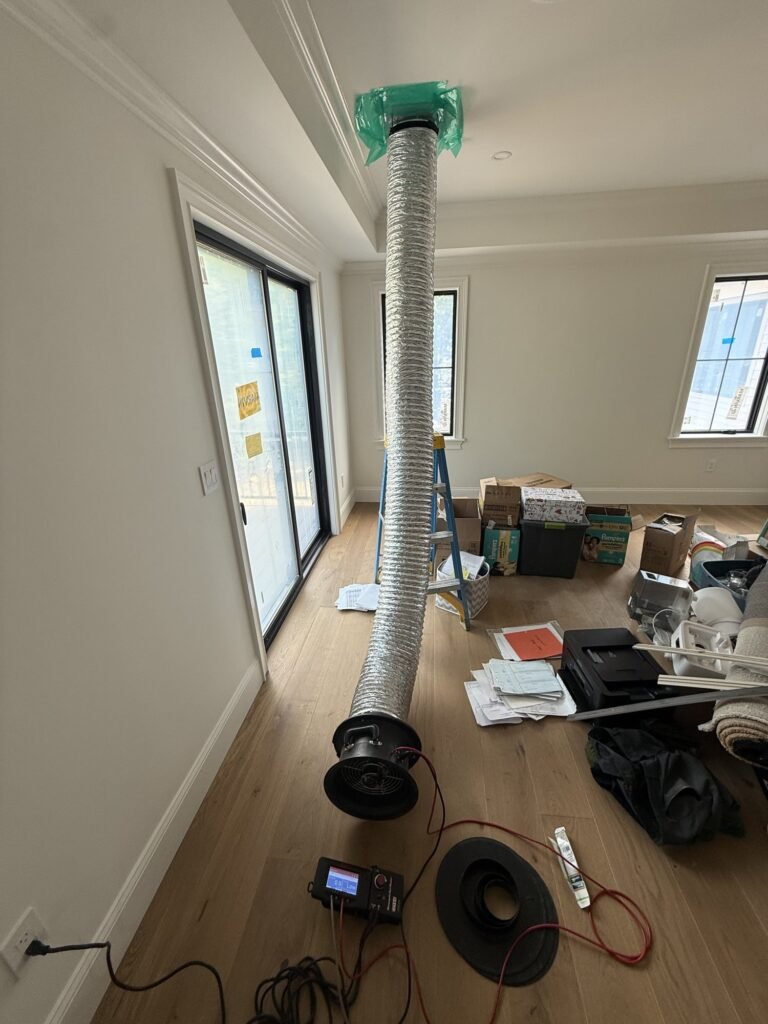
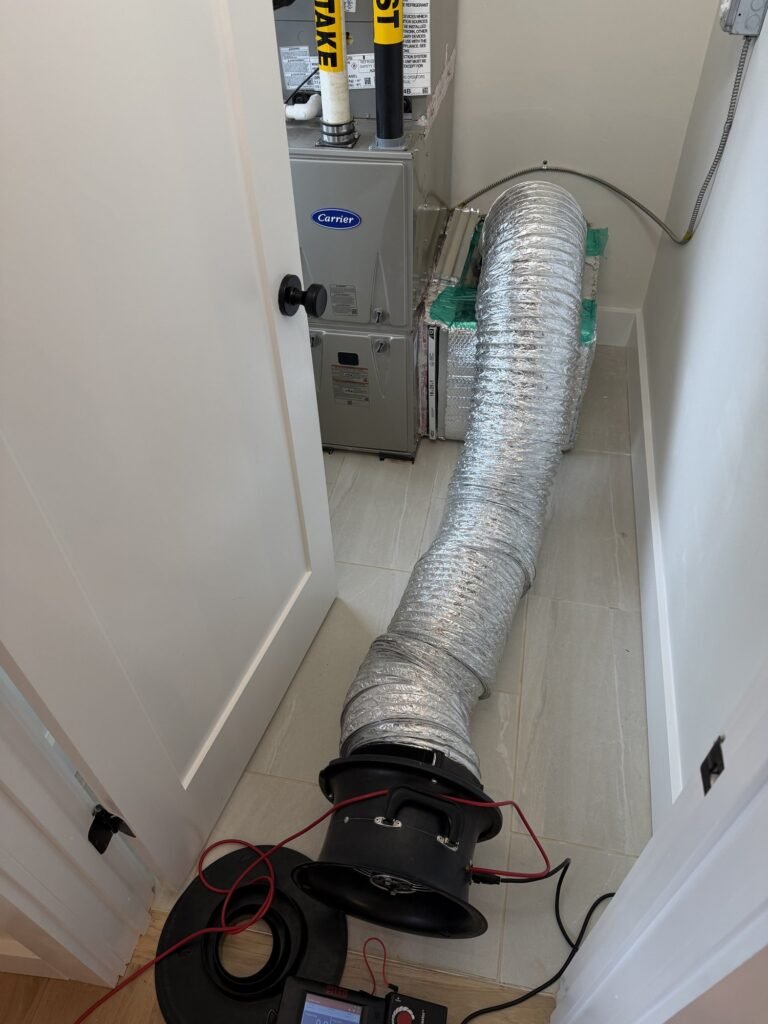
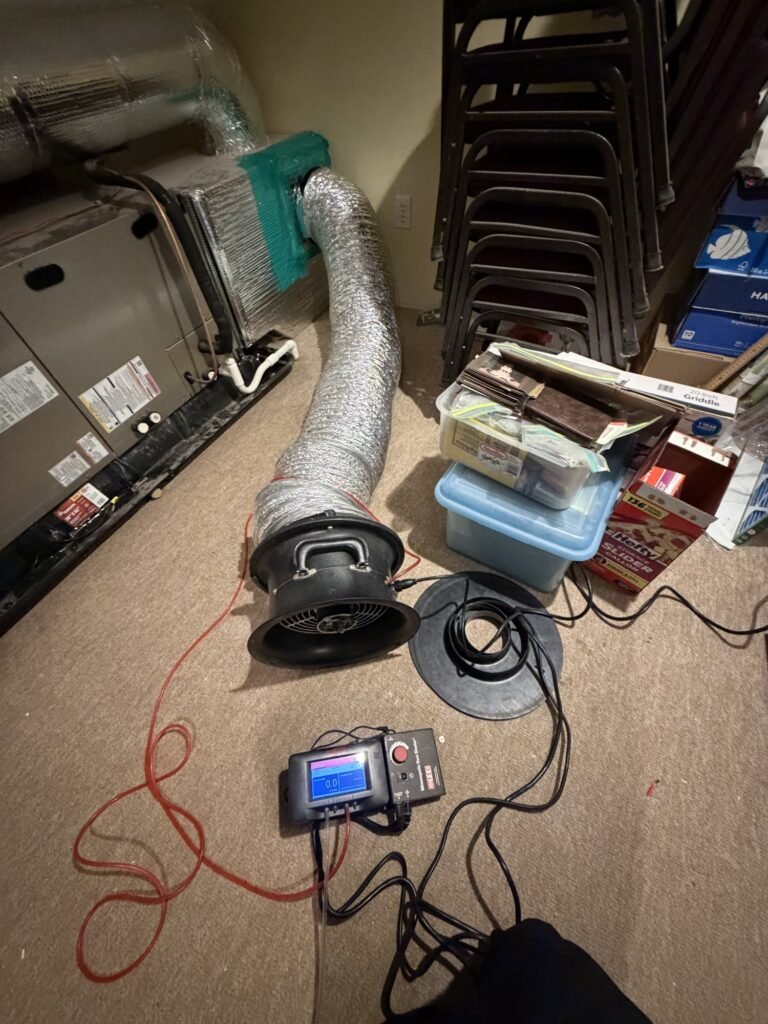
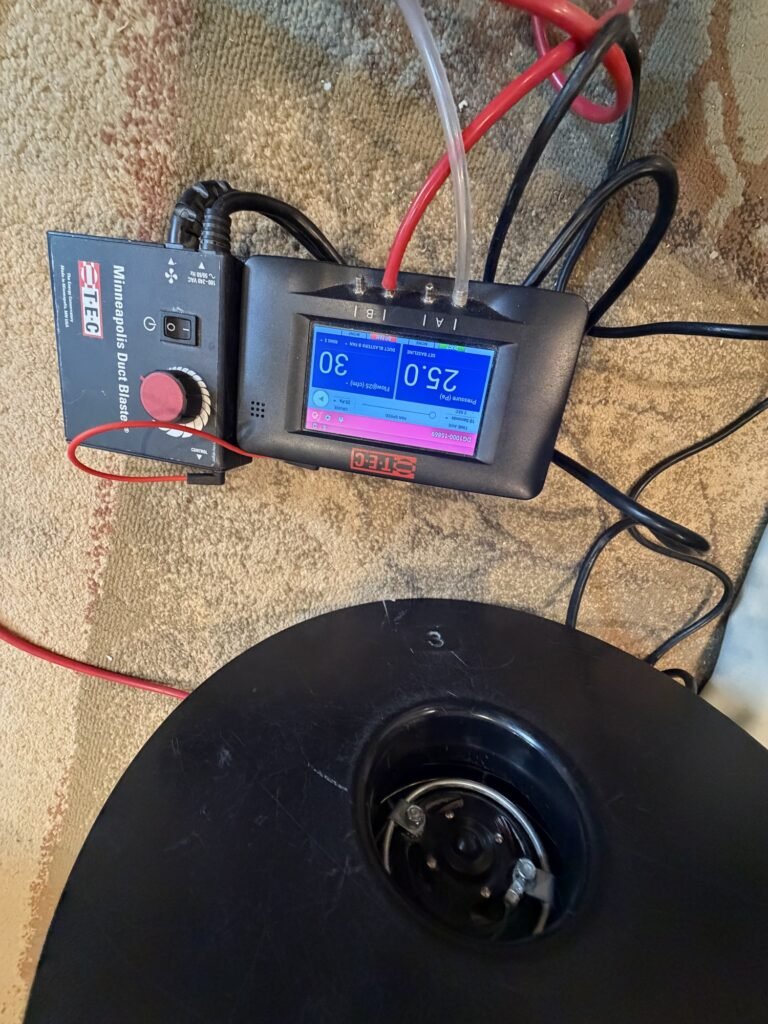
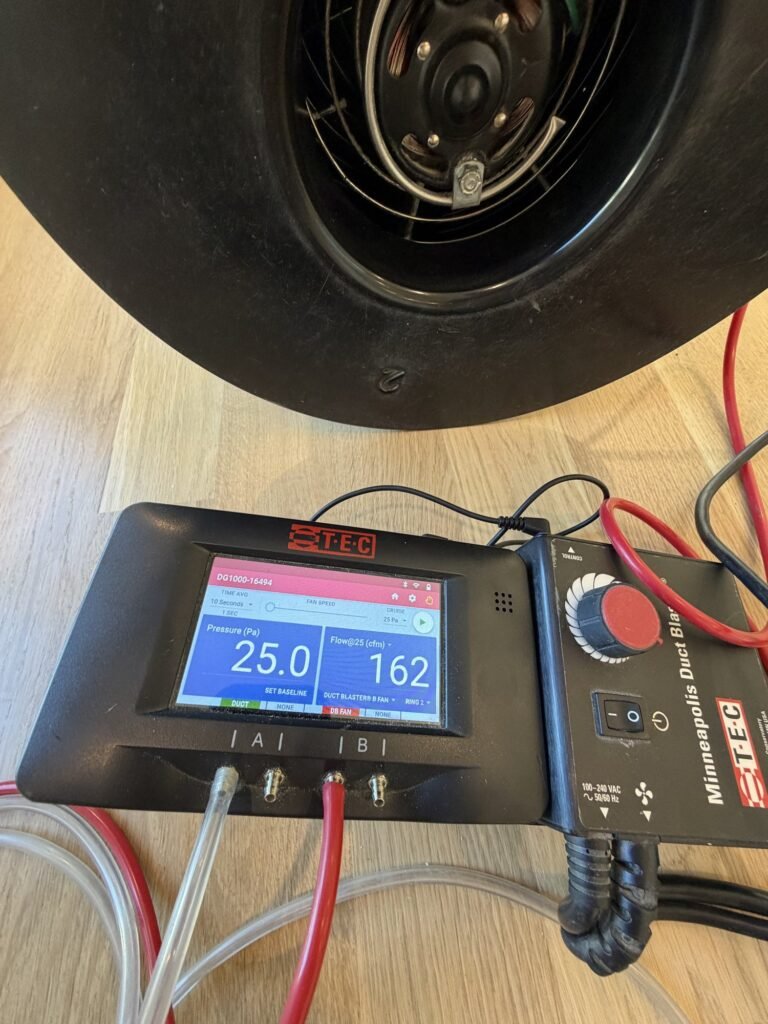
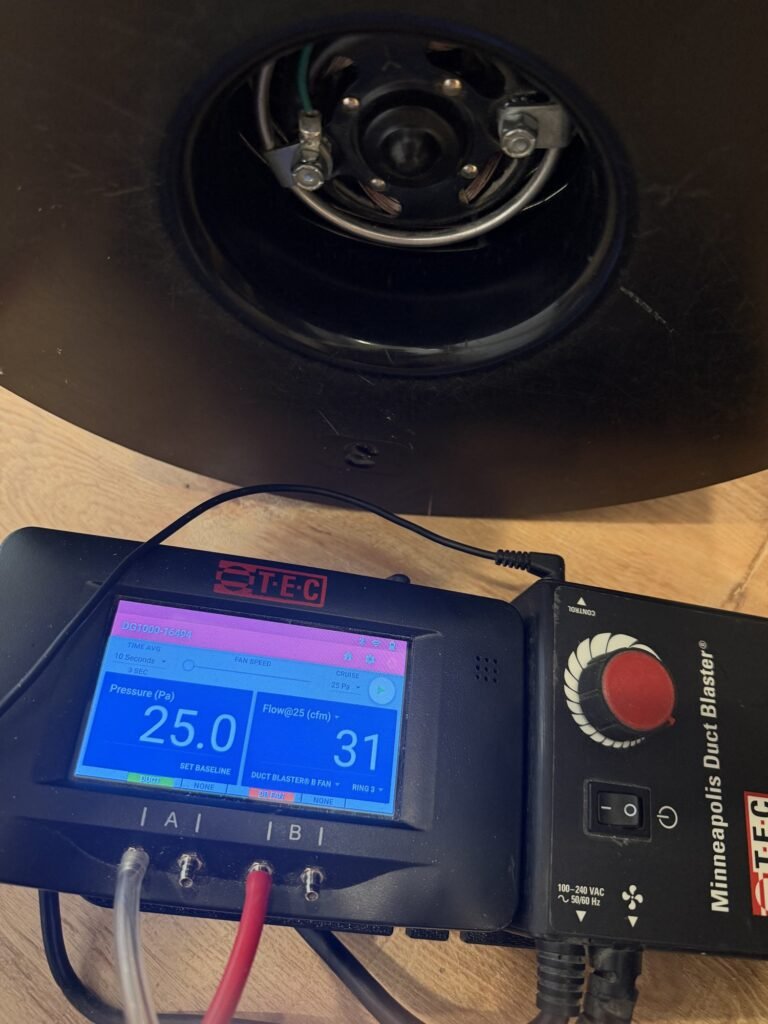
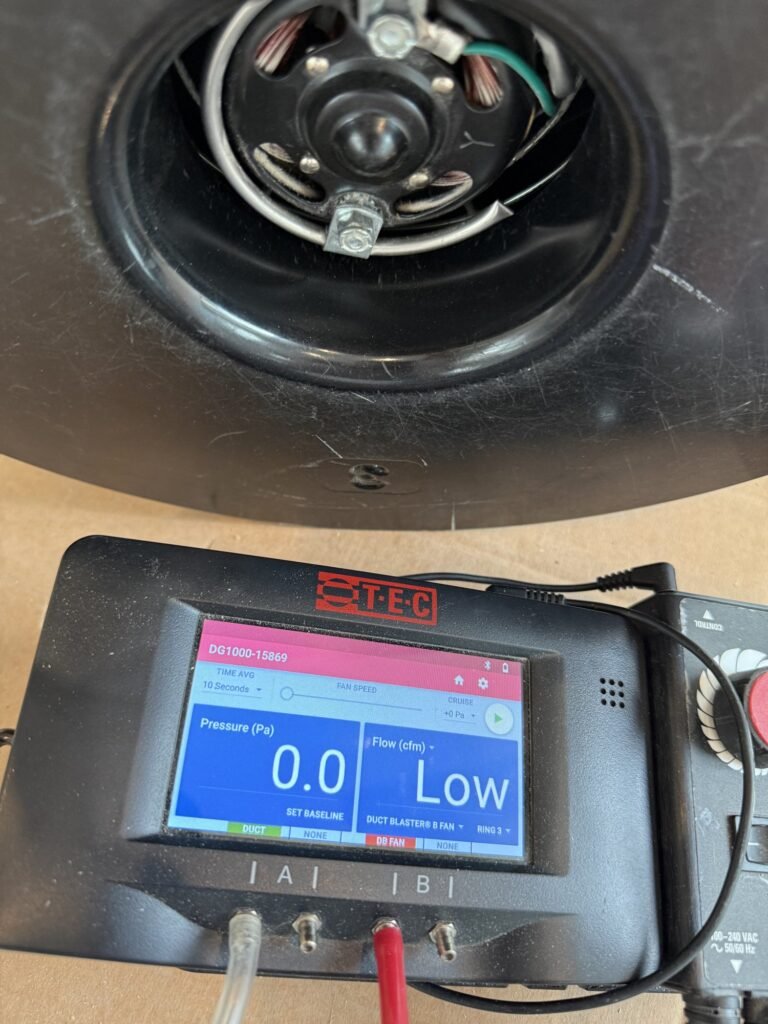
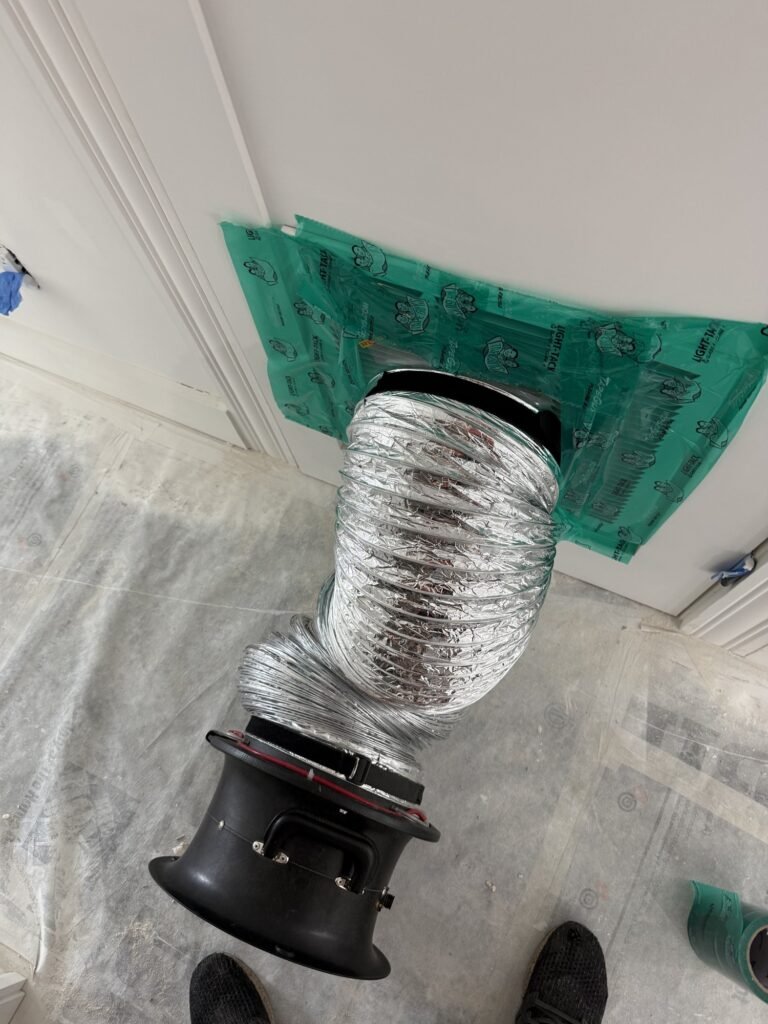
Registers are sealed, a calibrated duct tester pressurizes the system to 25 pascals, and leakage is measured in CFM25. Testing at rough-in — before drywall — is the smart time to catch problems, because sealing exposed ducts is fast and cheap. The test takes about an hour and results are provided on the spot.
Most failures come from unsealed boots and plenum connections, disconnected runs, and panned joist returns. We pinpoint the leaks during the test, your HVAC crew seals with mastic or approved tape, and we retest — usually the same visit. Pair it with blower door testing for full code compliance in one appointment.
Home Energy Efficiency Consultants is an ENERGY STAR® partner and U.S. DOE Efficient New Home partner (verified), rated 5.0 stars across 136 Google reviews, with offices in Somerville, Framingham, Marlborough, and Everett. Same-day scheduling: (617) 501-6788.
Last updated · Home Energy Efficiency Consultants, RESNET-certified HERS raters

 ENERGY STAR® Partner · U.S. DOE Efficient New Home Partner — Verified · Mass Save®-Listed HERS Rater
Same-day HERS ratings & blower door testing across Massachusetts. We respond within hours.
Get My Free Quote →