Duct Leakage Testing Marion MA - Quick Facts
Local energy code in Marion
- Marion is a Stretch Code community - the statewide baseline for new construction and major renovations. IECC Climate Zone 5A.
- Massachusetts has three energy-code levels - base (2021 IECC), Stretch, and Specialized (Opt-In) - and Marion is on the Stretch Code.
Duct leakage requirement in Marion
- Marion permits under the Massachusetts Stretch Code cap duct leakage at 4 CFM25 per 100 sq ft of conditioned floor area.
- Testing is required unless the entire duct system and air handler sit inside conditioned space; a rough-in test and a final test may both apply.
- Results in 24-48 hours with clear pass/fail documentation, filed with the Marion building department.
- From $350 for the first ducted system, often bundled with blower door testing and a full HERS rating.
Mass Save rebates for Marion (2026)
- Duct and blower door results feed the HERS rating that unlocks Mass Save all-electric incentives: $7,500 to $25,000 per new single-family home and $1,000 to $3,750 per multifamily unit.
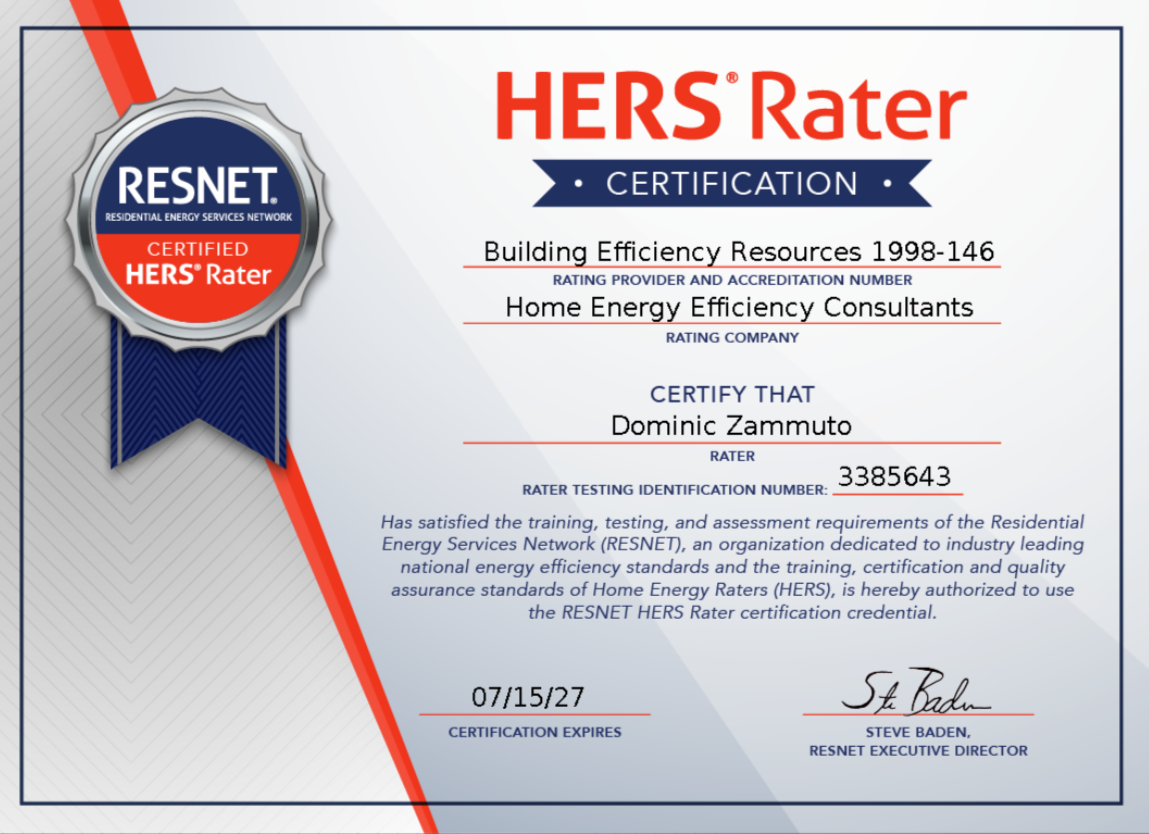
- Incentives require a Mass Save-approved, RESNET-certified HERS rater.
RESNET-certified · 15,000+ ratings completed · 5.0 stars across 136 Google reviews · (617) 501-6788
Duct Leakage Testing Marion MA
RESNET/HERS duct leakage testing in Marion — fast, precise CFM25 results your building department and energy-code file can rely on.
Duct Leakage Requirements in Marion
Marion follows the base energy code, which requires testing for ducts located outside the conditioned space at 4.0 CFM25 per 100 square feet. Our raters measure your ductwork in CFM25 and document a clear pass against the 4 CFM25 per 100 sq ft limit.
| Project / code tier | Duct leakage limit | What is tested |
|---|---|---|
| Base energy code | 4.0 CFM25 / 100 sq ft | Total leakage (ducts outside conditioned space) |
| Stretch Code | 4 CFM25 / 100 sq ft (total) | Total leakage (leakage to outside is not a code option) |
| Rough-in test, air handler not installed | 3.0 CFM25 / 100 sq ft | Total leakage (Stretch and Specialized) |
| Ducts fully inside envelope | 8.0 CFM25 / 100 sq ft (test still required) | Air handler + ducts in conditioned space |
IECC Duct Leakage Thresholds Reference
Beyond the Massachusetts tier that applies in Marion, these are the federal IECC duct-leakage limits across code editions. All values are CFM at 25 Pascals (CFM25) per 100 sq ft of conditioned floor area (CFA) unless noted.
2009 IECC
| Test stage | Measurement | Leakage limit |
|---|---|---|
| Postconstruction Leakage Test | Duct Leakage to Outdoors | ≤ 8 CFM25 / 100 sq ft CFA |
| Rough-in with AHU | Total Duct Leakage | ≤ 6 CFM25 / 100 sq ft CFA |
| Rough-in without AHU | Total Duct Leakage | ≤ 4 CFM25 / 100 sq ft CFA |
2012, 2015, 2018 & 2021 IECC — Prescriptive Paths
| Test stage | Measurement | Leakage limit |
|---|---|---|
| Postconstruction Leakage Test | Total Duct Leakage | ≤ 4 CFM25 / 100 sq ft CFA |
| Rough-in with AHU | Total Duct Leakage | ≤ 4 CFM25 / 100 sq ft CFA |
| Rough-in without AHU | Total Duct Leakage | ≤ 3 CFM25 / 100 sq ft CFA |
2015 & 2018 IECC — Performance Path (Cost Compliance)
Leakage testing is required unless all ducts and air handlers are located entirely within the thermal envelope. There is no pass/fail threshold for duct leakage on the performance path.
2024 IECC — Prescriptive Path
| Conditioned floor area | Condition at test | Total leakage limit |
|---|---|---|
| >1,000 sq ft CFA | Space-conditioning equipment not installed | < 3 return grilles: ≤ 3 CFM · 3+ return grilles: ≤ 4 CFM |
| >1,000 sq ft CFA | All components installed | < 3 return grilles: ≤ 4 CFM · 3+ return grilles: ≤ 6 CFM |
| >1,000 sq ft CFA | Equipment not installed, ducts entirely in conditioned space | < 3 return grilles: ≤ 6 CFM · 3+ return grilles: ≤ 8 CFM |
| >1,000 sq ft CFA | All components entirely in conditioned space | < 3 return grilles: ≤ 8 CFM · 3+ return grilles: ≤ 12 CFM |
| ≤1,000 sq ft CFA | Equipment not installed | ≤ 30 CFM |
| ≤1,000 sq ft CFA | All components installed | ≤ 40 CFM |
| ≤1,000 sq ft CFA | Equipment not installed, ductwork entirely in conditioned space | ≤ 60 CFM |
| ≤1,000 sq ft CFA | All components entirely in conditioned space | ≤ 80 CFM |
How Duct Leakage Testing Works in Marion
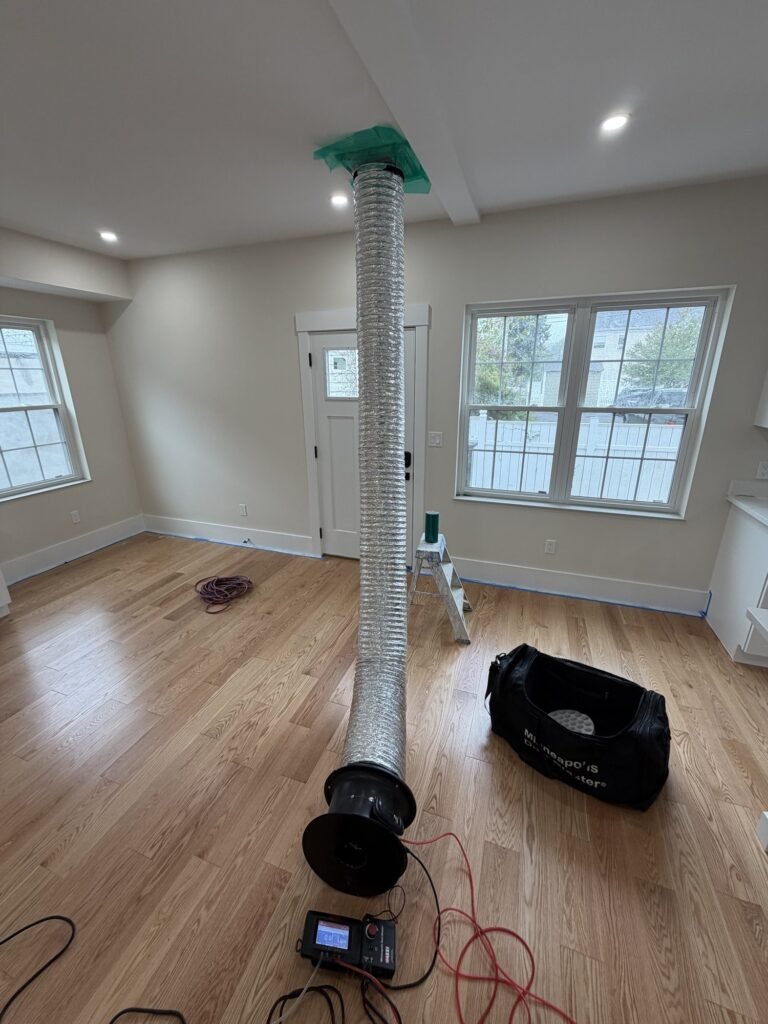
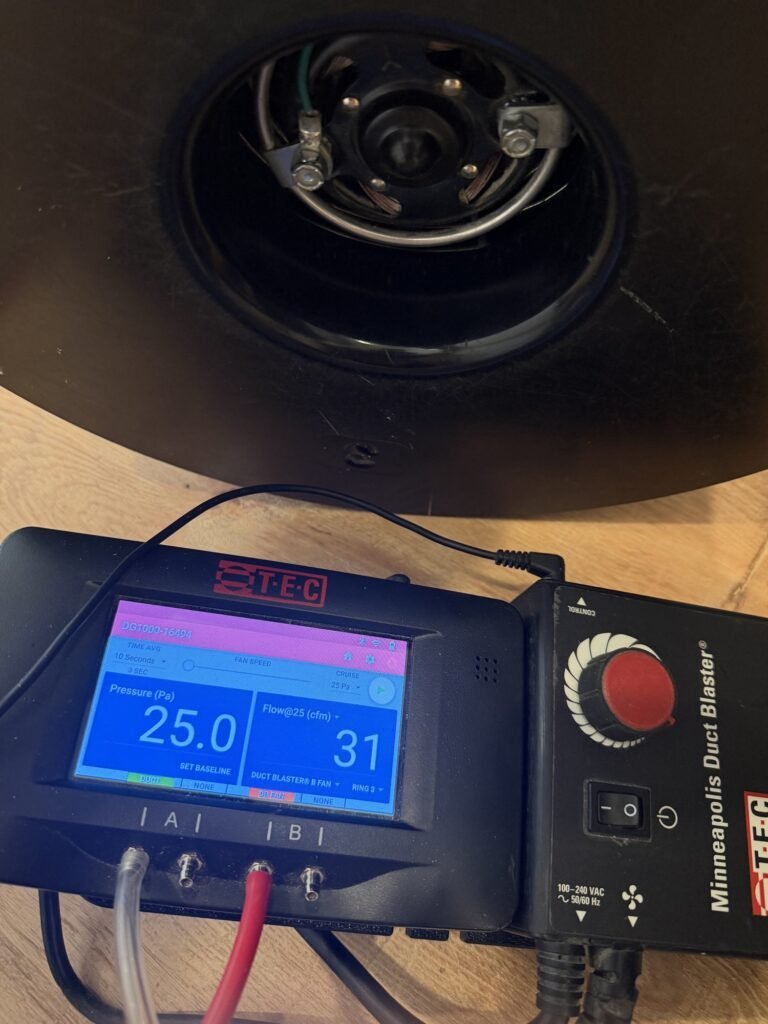
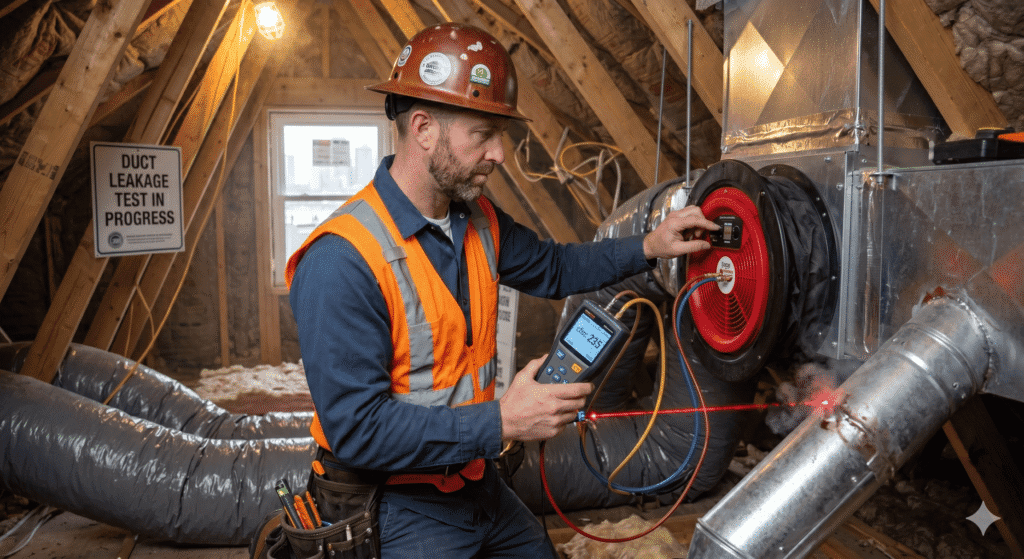
A duct blaster seals off your HVAC system and pressurizes it to 25 Pascals. The airflow needed to hold that pressure is your leakage rate in CFM25 — the lower the number, the tighter the ducts.
Common Sources of Duct Leakage We Check in Marion
Most duct leakage comes from a short list of predictable weak points. Knowing where to look is what turns a CFM25 number into a fixable list of locations.
Boot & register connections
The joint where a duct boot meets the drywall is the single most common leak point — often left unsealed behind the register grille.
Plenum & air-handler seams
Sheet-metal plenums and the cabinet of the air handler leak at seams and access panels unless mastic-sealed.
Disconnected flex runs
Flexible ducts can pull loose at collars or get crushed above insulation, dumping conditioned air into the attic.
Panned-joist returns
Return cavities framed from floor joists or wall studs are notoriously leaky and can draw in unconditioned air.
Building-cavity returns
Using framing cavities as return ducts pulls air from attics, garages, or crawlspaces instead of living space.
Trunk-line joints
Long supply trunks flex and separate at joints over time, especially where they were only taped rather than sealed with mastic.
Why Tight Ducts Keep Heat In Your Marion Home
Ductwork is the delivery system for every dollar of heating and cooling in a Marion home. If it leaks, that conditioned air is lost before it ever reaches a living space.
A verified-tight duct system means a right-sized furnace or heat pump can deliver its full output where it's needed, steadying comfort and cutting waste.
What Your Marion Duct Test Report Includes
You get a document your building department and HERS software will accept the first time — not just a number.
- ✓Documentation formatted for your HERS rating and building-permit file
- ✓A punch list of leak locations if a re-seal and retest is needed
- ✓Measured total duct leakage in CFM at 25 Pascals (CFM25)
- ✓Leakage normalized per 100 sq ft of conditioned floor area
- ✓Clear pass/fail against the 4.0 CFM25 limit that applies in Marion
- ✓The test method used (rough-in or post-construction) per ANSI/RESNET/ICC 380
Best Fit for Projects Like
- Marion projects that need both envelope air-tightness and duct testing documented in one visit
- Retest visits after sealing failing seams and boots to confirm compliance
- Custom homes with complex duct runs that need verification before final inspection
- Multi-unit conversions where each system needs documented duct leakage results
- Whole-home renovations pursuing energy-code sign-off in Plymouth County
Duct Leakage Testing Marion MA Facts
- Sealing before insulating and closing walls keeps the most expensive-to-reach leaks accessible during construction.
- The ENERGY STAR savings model assumes a typical unsealed home leaks about 23% of its total system airflow before duct sealing.
- The Total Leakage test seals every register boot and captures all leaks — inside the home and out.
- A duct air-leakage test is not required where the ducts and air handler sit entirely within the conditioned space.
Trusted for Duct Leakage Testing Marion MA
Our Massachusetts Service Locations
Serving clients from our Massachusetts locations in Everett, Somerville, and Framingham.
Everett Location
371 Main St
Everett, MA 02149
Somerville Location
519 Broadway
Somerville, MA 02145
Framingham Location
68 South St
Framingham, MA 01702
Real duct leakage tests by HEEC for Marion projects
These are photos from Home Energy Efficiency Consultants duct leakage testing jobs in Massachusetts — the same equipment and setup our certified raters bring to Marion homes.
Duct Leakage Testing Marion MA FAQ
Duct Leakage Test Requirements for Marion Projects
Marion is not on the Specialized Code list, so new homes follow the Massachusetts Stretch Code (225 CMR 22.00), adopted by 242 communities, or the base code if Marion has not adopted it. The testing requirements below come from 225 CMR 22.00 and the 2021 IECC it amends.

| Test | Limit (CFM25 per 100 sq ft of conditioned floor area) | Notes |
|---|---|---|
| Rough-in, air handler installed | 4.0 total leakage | ANSI/RESNET/ICC 380 or ASTM E1554 |
| Rough-in, air handler not installed | 3.0 total leakage | Air handler added later |
| Post-construction | 4.0 total leakage | Final test with the system complete |
| Ducts and air handler entirely inside the thermal envelope | 8.0 total leakage | Test is still required |
| Ventilation-only ducts | Exempt | Only if not tied into heating or cooling ducts |
Massachusetts measures total duct leakage; "leakage to outside" is not a code option. Under the Massachusetts amendment to R403.3.5, the test must be done by a HERS Rater, HERS Rating Field Inspector or BPI Certified Professional, with a signed report to the Marion building department. Mechanical ventilation airflow must also be tested and verified by a HERS Rater under R403.6.3.
Sources: 225 CMR 22.00 (2025 edition) and the 2021 IECC sections listed. Marion is in Plymouth County, served from our Framingham (68 South St) office.
Duct Leakage Questions from Marion Builders
What is the duct leakage limit for a new home in Marion?
4.0 CFM25 of total leakage per 100 square feet of conditioned floor area, at rough-in or after construction. If the air handler is not installed at rough-in the limit is 3.0, and if every duct and the air handler are inside the thermal envelope the limit is 8.0.
Can leakage to outside be used instead of total leakage?
No. The Massachusetts code (225 CMR 22.00 R403.3.5) measures total duct leakage. Leakage-to-outside tests are used by some programs, but not for code compliance here.
Who can perform the duct test in Massachusetts?
A HERS Rater, a HERS Rating Field Inspector or a BPI Certified Professional, under the Massachusetts amendment to R403.3.5. The tester signs a written report for the code official.
Is a duct test required if all ducts are inside conditioned space?
Yes. Massachusetts follows the 2021 IECC, which still requires the test but allows up to 8.0 CFM25 per 100 square feet when the ducts and air handler are entirely inside the thermal envelope.
Rough-in or final: which test is better?
A rough-in test catches leaks while every joint is still reachable, so fixes are cheap. A post-construction test confirms the finished system. Many builders do both to avoid surprises at final.
How much does duct leakage testing cost in Marion?
Our duct testing is $350 for the first ducted system and $250 for each additional system at the same address. It can be done in the same visit as the blower door test and HERS inspection.
Related: Blower door testing in Marion · HERS rating in Marion · Stretch Code help in Marion
Get Started With Duct Leakage Testing Marion MA
Fast scheduling and permit-ready CFM25 reports for Marion and all of Plymouth County.
Call 617-501-6788
Mass Save®-Listed HERS Rater
 U.S. DOE Efficient New Home
Trusted Partner — Verified
 ENERGY STAR®
Partner
 Phius Certified
Passive House Verifier
 ICC
ICCMember★★★★★136 Google
Reviews
The Phius Certified Verifier logo is used under license from Phius.
HERS Ratings in Marion, Massachusetts
Home Energy Efficiency Consultants provides Marion with certified HERS ratings, blower door and duct leakage testing, and Massachusetts energy-code compliance for new construction, additions, and major renovations — with same-day preliminary reports.
We rate homes across the Commonwealth from our four offices. Reach the one nearest your Marion project — Somerville, Framingham, Marlborough, or Everett — or call (617) 501-6788 to schedule a Marion rating.