When a home fails a duct leakage test, it’s rarely a surprise to the system — but it’s often a surprise to the homeowner or builder.
Duct leakage testing isn’t theoretical. It’s a measurable, code-enforced verification of how much conditioned air escapes through your duct system. If too much air leaks into attics, crawl spaces, or wall cavities instead of reaching living areas, the home fails compliance.
At Home Energy Efficiency Consultants, we see the same red flags repeatedly. If you know what to look for early, you can correct problems before inspection day.
Uneven Temperatures Throughout the Home
One of the clearest warning signs of duct leakage is inconsistent room temperatures.
If certain rooms feel:
- Hot in summer
- Cold in winter
- Hard to keep comfortable
that usually points to supply duct leakage or disconnected duct runs.
When conditioned air escapes before reaching the register vents, airflow drops. The HVAC system runs longer trying to compensate, but the rooms furthest from the air handler suffer first.
During a duct blaster test, this type of leakage shows up immediately as elevated CFM25 readings.
Weak Airflow From Vents
If airflow feels weak even when the system is running normally, the problem may not be the furnace or heat pump — it may be leaking duct connections.
Common causes include:
- Unsealed duct joints and seams
- Poorly connected plenums
- Crushed flexible ductwork
- Disconnected return ducts
Air should move under controlled static pressure. When ducts leak, pressure drops and airflow measurement results decline. That imbalance almost guarantees failure during duct pressure testing.
High Energy Bills Without a Clear Cause
Leaky ductwork wastes energy. Period.
If conditioned air is escaping into unconditioned spaces like attics or crawl spaces, the HVAC system must work harder to maintain thermostat setpoints. That increases:
- Runtime
- HVAC load
- Utility costs
- System wear
A home with significant duct leakage can lose 20–30% of conditioned air before it ever reaches living areas. That’s not just inefficient — it directly impacts energy efficiency ratings and HERS score performance.
If your bills feel out of proportion to the home’s size, duct leakage should be investigated.
Excessive Dust and Poor Indoor Air Quality
Leaky return ducts are especially problematic.
When return ducts are unsealed, they can pull:
- Insulation particles
- Attic dust
- Crawl space contaminants
- Allergens
into the HVAC system and distribute them throughout the home.
This creates:
- Excessive dust buildup
- Indoor air pollutants
- Air pressure imbalances
- Reduced indoor air quality
During testing, high leakage to outdoors often correlates with these conditions.
HVAC System Running Longer Than It Should
If your system runs long cycles or short cycles frequently, duct leakage may be contributing.
Air escaping from supply ducts forces the system to operate longer to compensate. Over time, this leads to:
- Increased energy waste
- Premature system failure
- Reduced system lifespan
- Higher repair costs
Duct leakage doesn’t just affect comfort — it accelerates mechanical wear on the air handler, evaporator coil, furnace, or heat pump.
Visible Installation Issues
Sometimes the signs are obvious.
If you see:
- Loose or unsealed duct boots
- Gaps at register vents
- Foil tape peeling off joints
- Flex ducts sharply bent or crushed
- Sheet metal ducts with unsealed seams
you likely have measurable leakage.
Proper duct sealing requires mastic sealant or code-approved sealing methods — not generic tape that deteriorates over time.
Improper HVAC installation is one of the most common reasons homes fail energy code compliance testing.
Learn More: HERS Duct Testing vs Blower Door Testing: Key Differences Explained
Whistling, Rattling, or Air Noise in Ducts
Audible duct noise is often a pressure imbalance issue.
When static pressure is disrupted due to leakage, airflow may create:
- Whistling sounds
- Rattling duct sections
- Air turbulence near dampers
While noise alone doesn’t confirm failure, it’s a strong indicator of airflow irregularities that show up during duct blaster testing.
The Home Is Preparing for Energy Code Inspection
If your project is new construction or a major renovation, and ductwork hasn’t been sealed to current IECC or RESNET standards, you are at risk.
Most jurisdictions require:
- Total duct leakage limits
- Leakage to outdoors thresholds
- Verified air tightness documentation
Failing a duct leakage inspection can delay:
- Building inspections
- Certificate of occupancy
- Project completion
And rework after drywall or finishes are complete is expensive.
What Happens During a Duct Leakage Test
Understanding the process clarifies why failures occur.
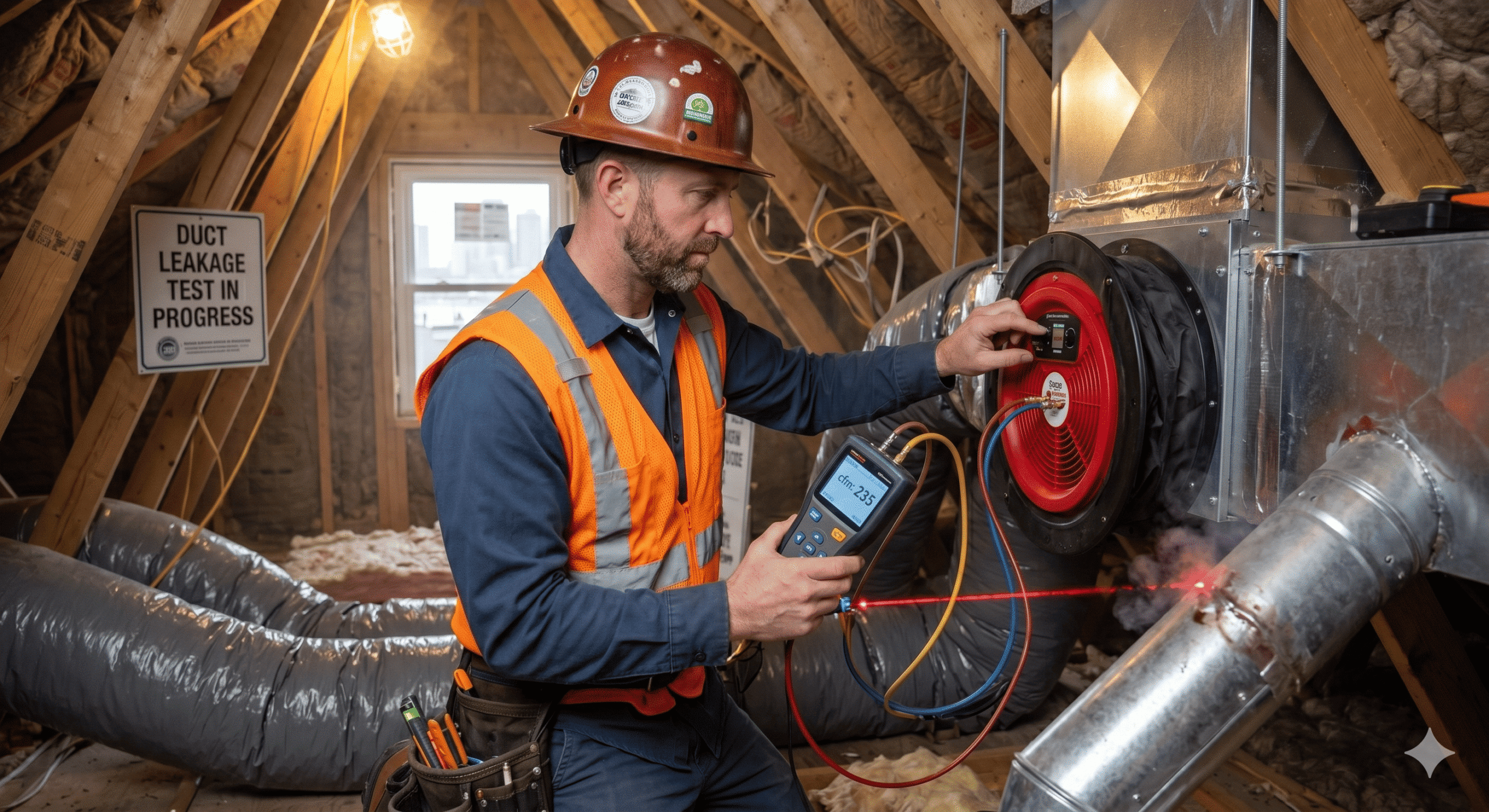
A certified rater uses a duct blaster system to:
- Pressurize the duct system
- Measure airflow leakage (CFM25)
- Calculate total duct leakage
- Determine leakage to outdoors
Results are compared against code requirements and project specifications. If numbers exceed allowable limits, corrections must be made before final approval.
This is not a visual guess — it’s performance-based verification.
How to Prevent Failing a Duct Leakage Test
If any of the signs above apply, corrective action should happen before inspection.
Key steps include:
- Sealing all duct joints with mastic sealant
- Securing flex ducts properly
- Verifying airtight connections at the air handler
- Sealing duct boots to drywall
- Insulating ducts in unconditioned spaces
Testing early — before finishes are complete — prevents costly rework.
Learn More: How to Earn HERS Points with Low GWP Concrete Mixes in Massachusetts
Why Early Testing Matters
Many builders wait until final inspection to test. That’s a mistake.
If duct leakage is excessive, access becomes difficult after drywall, trim, and insulation are complete. Fixing hidden duct runs can require major disruption.
At Home Energy Efficiency Consultants, we recommend proactive duct pressure testing during construction phases to catch issues early and protect your project timeline.
Energy code compliance should never be left to chance.
The Bottom Line
If your home has:
- Uneven temperatures
- Weak airflow
- Rising energy bills
- Excess dust
- Visible duct gaps
- Long HVAC runtimes
there’s a strong possibility your system would struggle during a duct leakage test.
Duct leakage is measurable. It affects comfort, efficiency, indoor air quality, and inspection approval. Ignoring the signs doesn’t make them disappear — it just delays the inevitable correction.
If your project requires verification or you suspect performance issues, professional testing provides clarity. Accurate diagnostics prevent failed inspections, unnecessary delays, and wasted energy.
That’s the difference between guessing — and knowing.