
Massachusetts builders are under increasing pressure to deliver homes that meet aggressive energy and carbon benchmarks. HERS scores are no longer just a marketing metric—they are tied directly to code compliance, incentives, permitting expectations, and resale value. One area that is gaining real traction is the use of low Global Warming Potential (GWP) concrete mixes, particularly in foundations and slabs.
Low-GWP concrete does not magically reduce a HERS score on its own. When integrated correctly into the building envelope and documented properly, it supports better thermal performance, cleaner energy modeling results, and smoother verification. This article breaks down exactly how that works in practice.
Role of HERS Scores in Massachusetts Residential Construction
The Home Energy Rating System (HERS) Index is the primary tool used to quantify the energy efficiency of a residential building. A lower score indicates lower modeled energy consumption compared to a reference home built to minimum code.
In Massachusetts, HERS scores are used to:
- Demonstrate compliance with the Stretch Energy Code
- Qualify for energy efficiency incentives
- Support certifications tied to advanced building performance
- Validate design assumptions during plan review
HERS ratings are administered under standards established by RESNET, and while the index is energy-focused, the materials used in the building shell strongly influence modeled outcomes.
Concrete, particularly in foundations and slabs, plays a larger role than many builders realize.
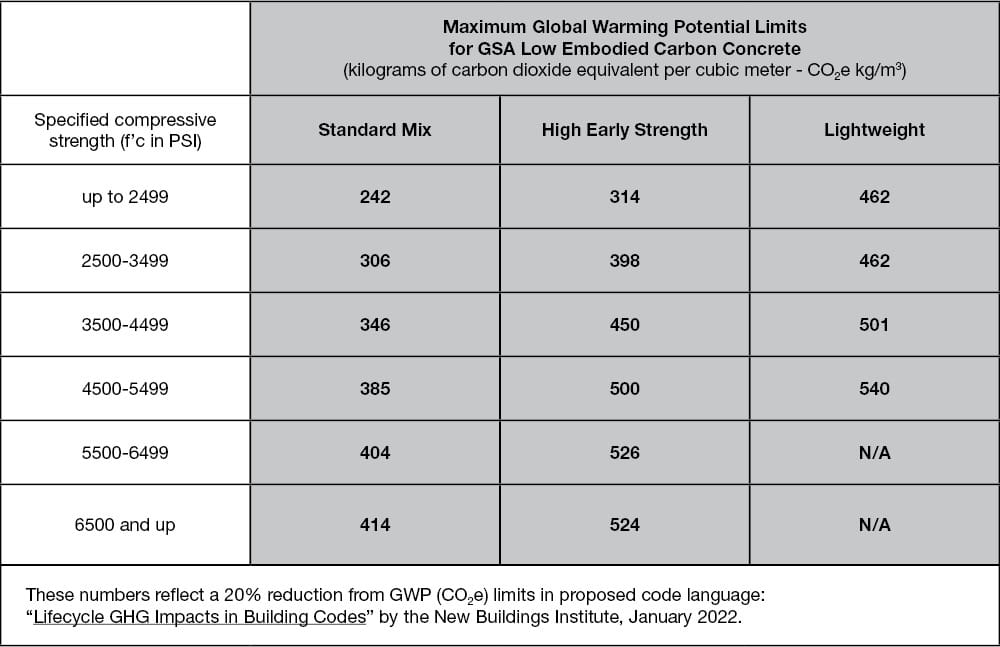
Global Warming Potential and Concrete Mix Design
Global Warming Potential measures how much a material contributes to climate change relative to carbon dioxide. Conventional concrete relies heavily on Portland cement, which is one of the most carbon-intensive materials used in construction.
Low-GWP concrete reduces embodied carbon by:
- Substituting Portland cement with supplementary cementitious materials (SCMs)
- Optimizing cement content without sacrificing structural performance
- Using performance-based mix specifications rather than prescriptive formulas
Common SCMs include fly ash, slag cement, and other industrial byproducts that dramatically lower carbon emissions per cubic yard of concrete.
From a structural standpoint, these mixes perform the same. From an environmental and regulatory standpoint, they perform far better.
Connection Between Low GWP Concrete and HERS Modeling
HERS modeling does not assign points simply for using low-carbon materials. The benefit comes from how low-GWP concrete supports overall building performance.
Concrete foundations and slabs influence:
- Heat transfer through the building envelope
- Air sealing continuity
- Thermal mass behavior
- Moisture durability and long-term efficiency
When low-GWP concrete is paired with proper insulation, thermal breaks, and airtight detailing, it enables energy models to show reduced heating and cooling demand—directly lowering the HERS score.
If the concrete is poured without coordination, the benefit is lost.
Thermal Mass Performance and Energy Stability
Concrete has high thermal mass, meaning it absorbs and releases heat slowly. In Massachusetts’ climate, this can stabilize indoor temperatures when designed correctly.
Low-GWP concrete performs identically to traditional concrete in this respect. The advantage comes when:
- Slab edges are insulated
- Foundations are detailed to reduce thermal bridging
- The thermal mass is located inside the conditioned envelope
This improves modeled heating efficiency in winter and moderates temperature swings during shoulder seasons, both of which are captured in HERS simulations.
Compatibility with High-Performance Building Envelopes
Low-GWP concrete is commonly used in advanced envelope systems such as:
- Insulated concrete forms (ICFs)
- High-performance slab-on-grade assemblies
- Frost-protected shallow foundations
- Passive House–influenced designs
These assemblies reduce energy loads substantially. HERS raters evaluate the envelope as a system, not as individual materials.
If low-GWP concrete enables better insulation placement, improved air sealing, or cleaner detailing, it indirectly improves HERS outcomes.
Alignment with Massachusetts Energy Codes and Policies
Massachusetts is ahead of most states in linking building performance to climate goals. Stretch energy codes, municipal fossil fuel restrictions, and embodied carbon discussions are reshaping expectations for residential construction.
Using low-GWP concrete helps projects:
- Align with emerging embodied carbon benchmarks
- Support municipalities with stricter environmental review
- Reduce risk of future retrofit requirements
- Demonstrate proactive compliance during inspections
While HERS itself focuses on operational energy, local regulators increasingly view low-carbon material choices as part of responsible design.
Learn More: Top Causes of Air Leaks in New Homes (And How Massachusetts Builders Can Avoid Them)
Documentation Standards Required for HERS Verification
This is where many builders fail.
If a low-GWP concrete mix is not documented, it does not exist from a verification standpoint.
Proper documentation includes:
- Concrete mix designs listing SCM percentages
- Product data sheets from suppliers
- Environmental Product Declarations (EPDs), when available
- Coordination notes showing integration with insulation and air sealing plans
HERS raters rely on documentation to validate assumptions used in modeling. Missing paperwork leads to conservative defaults, which raise the final score.
Coordination Timing That Maximizes HERS Benefits
The timing of decisions matters more than the material itself.
The optimal sequence looks like this:
- Energy consultant engaged during schematic design
- Foundation and slab assemblies modeled early
- Low-GWP concrete specified alongside insulation strategy
- Documentation collected before construction begins
- HERS rater looped in before pour schedules are finalized
Waiting until after concrete placement eliminates most optimization opportunities.
Common Errors That Undermine HERS Performance
Several recurring mistakes prevent low-GWP concrete from delivering real value:
- Treating it as a standalone sustainability upgrade
Without envelope integration, the impact is negligible. - Engaging HERS professionals too late
Retroactive modeling adjustments are limited. - Ignoring slab edge and foundation insulation
Thermal bridging negates thermal mass benefits. - Assuming supplier claims are sufficient
Verifiable documentation is mandatory.
These errors don’t just reduce efficiency—they inflate costs with no measurable return.
Practical Strategies for Builders and Developers
Builders aiming for lower HERS scores should focus on execution, not labels.
Effective strategies include:
- Specifying performance-based concrete mixes
- Coordinating concrete, insulation, and air barrier trades
- Using low-GWP concrete where thermal mass is inside the envelope
- Maintaining a clean documentation trail
- Reviewing modeled assumptions before construction begins
This approach reduces surprises during final rating and inspection.
Role of Home Energy Efficiency Consultant in Low-GWP HERS Planning
Home Energy Efficiency Consultant works with residential builders, developers, and homeowners across Massachusetts to translate material choices into measurable HERS improvements.
Their role includes:
- Early-stage HERS modeling and scenario analysis
- Review of foundation and slab assemblies
- Guidance on low-GWP concrete specifications
- Documentation support for verification
- Coordination between designers, contractors, and raters
The goal is not theoretical efficiency—it’s a verified, defensible HERS score that holds up during inspection and resale.
Learn More: HERS Duct Testing vs Blower Door Testing: Key Differences Explained
Final Perspective
Low-GWP concrete is not a shortcut, a gimmick, or a marketing checkbox. In Massachusetts, it is a tool that—when used intelligently—supports stronger envelope performance, cleaner energy modeling, and future-ready compliance.
If it’s specified late, poorly documented, or disconnected from the building system, it delivers nothing. If it’s integrated early and executed properly, it becomes part of a measurable strategy that lowers HERS scores and reduces long-term risk.