Blower Door Testing Hamilton MA - Quick Facts
Local energy code in Hamilton
- New construction and major renovations in Hamilton follow the Massachusetts Stretch Energy Code. IECC Climate Zone 5A.
- Massachusetts has three energy-code levels - base (2021 IECC), Stretch, and Specialized (Opt-In) - and Hamilton is on the Stretch Code.
Blower door requirement in Hamilton
- New homes in Hamilton must test at 3.0 ACH50 or tighter under the Massachusetts Stretch Code.
- Air-leakage testing is mandatory, measured with a calibrated blower-door fan to the RESNET / ASTM protocol - there is no inspection-only substitute for the result.
- Companion duct leakage limit: 4.0 CFM25 per 100 sq ft of conditioned floor area total leakage (8.0 when all ducts are inside conditioned space - the test is still required).
- Same-day preliminary results; final report in 24-48 hours, filed with the Hamilton building department.
What you can get back: 2026 Mass Save
- A tight result unlocks Mass Save all-electric incentives ($7,500 to $25,000 per new single-family home); an all-electric renovation testing at 3.0 ACH50 or better reaches the Level 2 tier, up to $30,000.
- Incentives require a Mass Save-approved, RESNET-certified HERS rater.
RESNET-certified · 15,000+ ratings completed · 5.0 stars across 136 Google reviews · (617) 501-6788
Blower Door Testing Hamilton MA
Certified blower door testing in Hamilton - we measure your home's air-tightness in ACH50, pinpoint leaks, and document a passing result for your building permit.
Air-tightness at a glance
Blower Door Testing Hamilton MA
A blower door test is the code-required way to prove how airtight a home in Hamilton really is. A calibrated fan depressurizes the house to 50 Pascals so we can measure exactly how much air leaks through the envelope, reported as air changes per hour (ACH50). New construction must reach 3.0 ACH50 or lower, and no home on any compliance path may exceed 5.0 ACH50 (IECC 2021 R402.4.1.2).
| Project type | Max ACH50 | Notes |
|---|---|---|
| New construction | 3.0 or lower | Mandatory blower-door test under R402.4.1.2 |
| Maximum on any compliance path | 5.0 | Code cap under IECC 2021 R402.4.1.2 |
| Addition < 1,000 sq ft | Exempt* | May be exempt from testing (R502.3.1) |
| Passive House (PHI; Phius uses 0.06 CFM50/sq ft) | 0.6 | Whole-building test, Phius/PHI protocol |
*Confirm with your local building department. Requirements per the 2025 MA Stretch Energy Code Technical Guidance.
How Blower Door Testing Works in Hamilton
The fan mounts in an exterior doorway and holds the home at a fixed 50-Pascal pressure difference - about what a 20 mph wind would exert. The airflow required to maintain that pressure, in CFM, converts to ACH50 using the home's conditioned volume.
The code converts the result to Q50 (CFM at 50 Pa) with Q50 = (Volume × ACH50) ÷ 60. A 2,700 sq ft home at 2 ACH50 works out to roughly 810 CFM50.
Keeping Heat In During Hamilton Cold Spells
During a New England cold snap the stack effect goes to work: warm indoor air rises and slips out near the top of the house, and that pulls cold outdoor air in through gaps down low. The colder it gets, the harder this effect pushes - so a leaky home loses the most heat exactly when it can least afford to.
A tight, tested envelope shrinks the infiltration share of your heating load. That lets the equipment keep up during cold spells, holds rooms at a steadier temperature between cycles, and often lets a designer right-size the heating system rather than oversizing it to cover leakage.
Lower heating load
Less infiltration means a smaller winter heat-loss load and equipment that can keep up.
Retain paid-for heat
Warm air stays in the living space instead of escaping out the top of the house.
Steadier comfort
Fewer cold-floor drafts and a temperature that holds between heating cycles.
Where Hamilton Homes Leak Air
During depressurization the leaks are exaggerated, making them easy to find. In Essex County's older housing stock the usual suspects are rim joists, top plates, attic hatches, recessed lights, and penetrations for plumbing and wiring. Coastal and exposed sites feel wind-driven infiltration most, so a tight, verified envelope pays back quickly here.
Best Fit for Projects Like
- Homes chasing Passive House or net-zero targets
- Additions over 1,000 sq ft that trigger testing
- Certificate-of-occupancy sign-off
- Drafty existing homes seeking targeted air sealing
- Custom and high-performance builds
Blower Door Testing Hamilton MA Facts
Why 50 Pascals
The 50-Pascal test pressure simulates roughly a 20 mph wind pushing on every surface of the building at once, giving a repeatable, weather-independent leakage number.
Passive House airtightness
On the Specialized Code / Passive House path, whole-building airtightness follows Phius or PHI protocols - often around 0.6 ACH50, roughly ten times tighter than base code.
Right-sizing equipment
A verified-tight envelope lets a designer right-size the furnace, boiler, or heat pump instead of oversizing for leakage - lowering both equipment cost and running cost.
When the test happens
The blower door test is typically run near completion, once the air barrier, windows, and penetrations are sealed but while any needed corrections are still easy to make.
Trusted for Blower Door Testing Hamilton MA
One of the most reliable HERS rating companies I have dealt with in Massachusetts.
This company does all my inspections. I use this company a lot and highly recommend them.
Knowledgeable and professional. Highly recommend them if you want a thorough efficiency assessment.
Our Massachusetts Service Locations
Serving clients from our Massachusetts locations in Everett, Somerville, and Framingham.
Everett Location
371 Main St
Everett, MA 02149
Somerville Location
519 Broadway
Somerville, MA 02145
Framingham Location
68 South St
Framingham, MA 01702
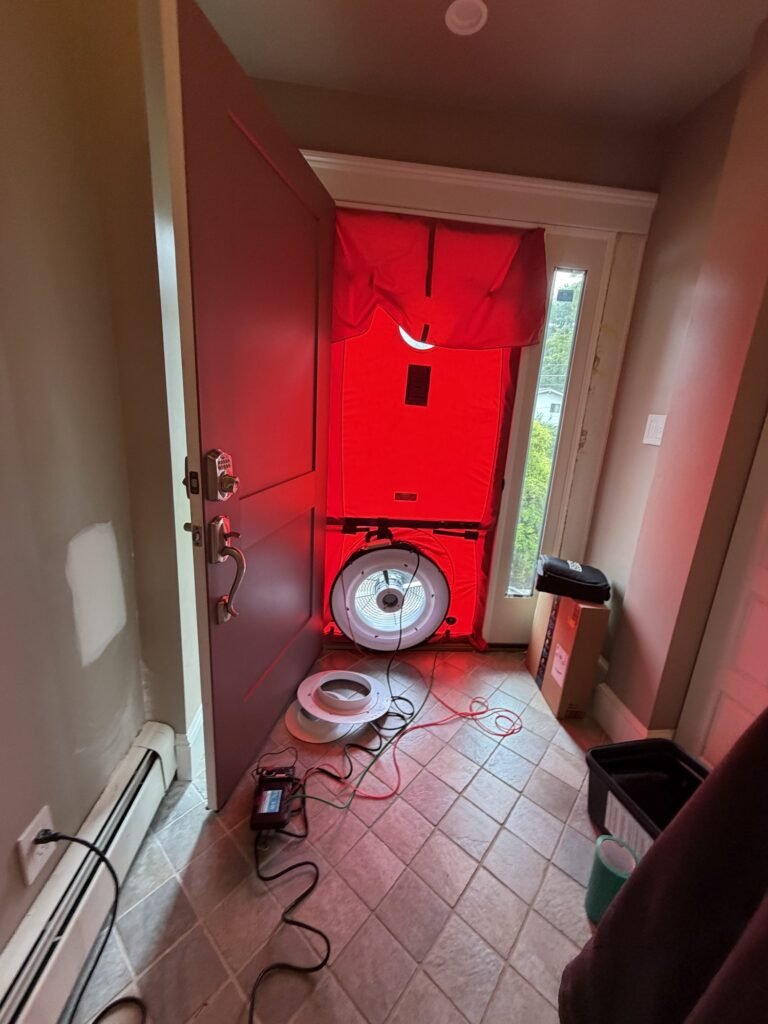
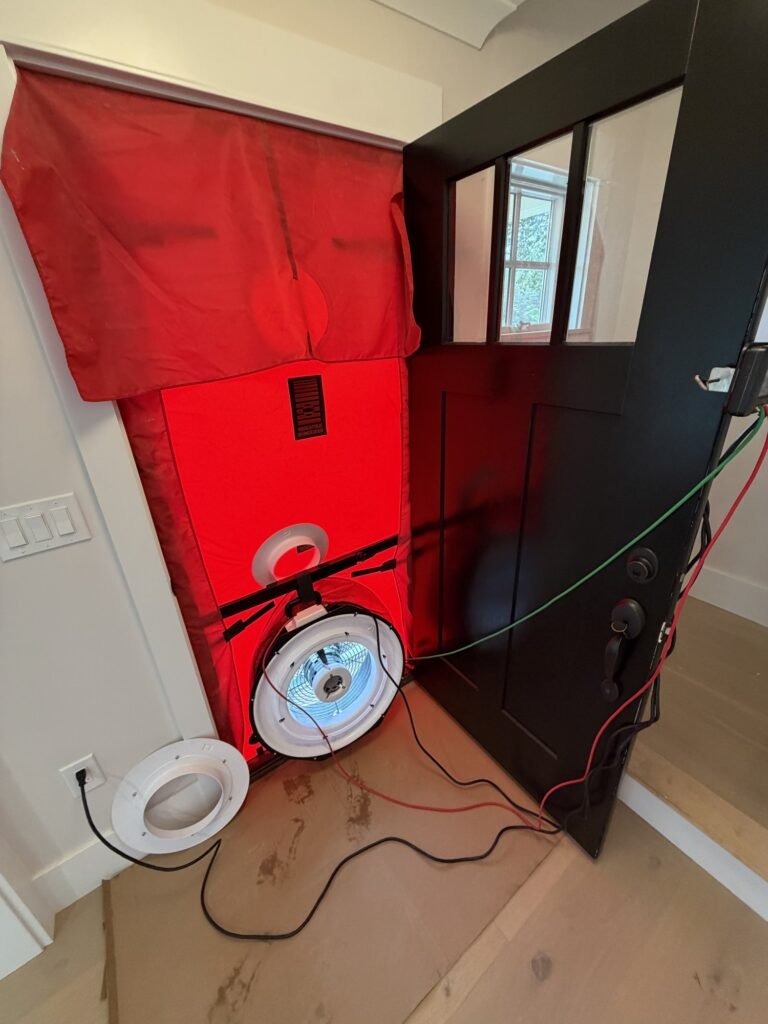
Real blower door tests by HEEC for Hamilton projects
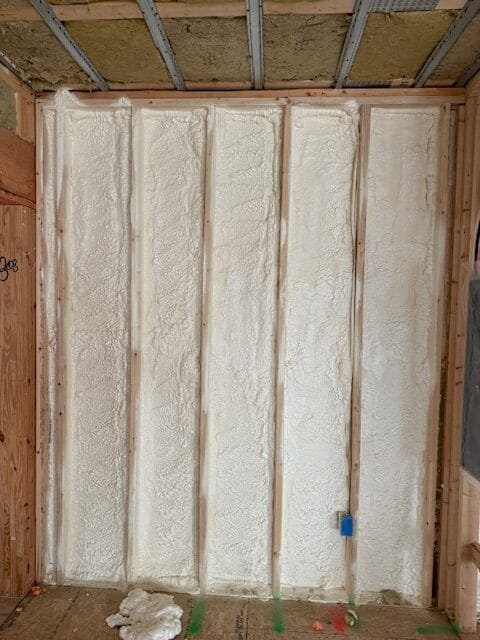
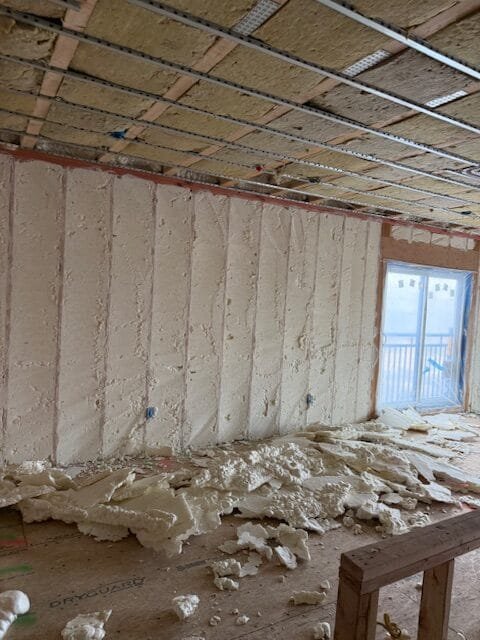
These are photos from Home Energy Efficiency Consultants blower door testing jobs in Massachusetts — the same equipment and setup our certified raters bring to Hamilton homes.
FAQ About Blower Door Testing Hamilton MA
What happens if my home fails the test?
The rater locates the leaks with smoke, an infrared camera, or by feel, those areas are sealed, and the home is retested until it meets the target.
How tight is a Passive House?
PHI Passive House projects must test at 0.6 ACH50 or lower. Phius projects use a different limit: 0.06 CFM50 per square foot of building enclosure (0.08 for non-combustible buildings of 5+ stories), verified with a multi-point whole-building blower door test.
How is ACH50 converted to CFM?
The code uses Q50 = (conditioned volume x ACH50) / 60. For example, a 2,700 sq ft home with 9 ft ceilings at 2 ACH50 equals about 810 CFM50.
Where do most leaks occur?
Common culprits are rim joists, top plates, attic hatches, recessed lights, plumbing and wiring penetrations, and gaps around windows and doors.
What ACH50 does new construction need to pass?
New residential construction in Massachusetts must measure 3.0 ACH50 or lower. Many high-performance homes come in well below that figure.
Will sealing my home cause moisture problems?
No - controlled tightness plus proper ventilation actually reduces moisture problems, because you stop humid air from moving through and condensing inside assemblies.
Blower Door Test Requirements for Hamilton Projects
Hamilton is not on the Specialized Code list, so new homes follow the Massachusetts Stretch Code (225 CMR 22.00), adopted by 242 communities, or the base code if Hamilton has not adopted it. The testing requirements below come from 225 CMR 22.00 and the 2021 IECC it amends.

| Requirement | Limit | Source |
|---|---|---|
| New home, prescriptive path | 3.0 ACH50 or lower | IECC 2021 R402.4.1.3 (Climate Zone 5, all of Massachusetts) |
| Maximum on any compliance path | 5.0 ACH50 or 0.28 CFM50 per sq ft of enclosure | IECC 2021 R402.4.1.2 |
| Attached homes and apartments tested unit by unit | 0.30 CFM50 per sq ft of unit enclosure (alternative) | IECC 2021 R402.4.1.2 exception |
| Mass Save ENERGY STAR tier | 1.5 ACH50 or lower | Mass Save new construction program |
| Passive House (PHI) | 0.6 ACH50 or lower | Passive House Institute |
| Passive House (Phius) | 0.06 CFM50 per sq ft of enclosure (0.08 for non-combustible 5+ stories) | Phius 2024 Certification Guidebook |
How the house is set up for the test
- Exterior windows and doors closed, with no sealing beyond normal weatherstripping
- Dampers closed but not taped, and interior doors open
- Exterior ventilation openings sealed, heating and cooling turned off, supply and return registers open
- Tested at 50 Pascals per ANSI/RESNET/ICC 380, ASTM E779 or ASTM E1827, with a signed report for the Hamilton building department
Sources: 225 CMR 22.00 (2025 edition) and the 2021 IECC sections listed. Hamilton is in Essex County, served from our Everett (371 Main St) office.
Blower Door Questions from Hamilton Builders
What blower door number does a new home in Hamilton need?
On the prescriptive path the 2021 IECC requires 3.0 ACH50 or lower in Massachusetts, and no home on any path may exceed 5.0 ACH50. Homes on the HERS path are tested the same way, and the result goes into the HERS model, so a tighter house earns a lower HERS score.
What is ACH50?
Air changes per hour at 50 Pascals: how many times the home's air volume leaks out each hour while a blower door holds the house at 50 Pa. ACH50 = CFM50 × 60 ÷ conditioned volume.
How are townhouses and apartments tested?
Each dwelling unit can be tested on its own and meet 0.30 CFM50 per square foot of the unit's enclosure, which counts walls, floor and ceiling shared with neighbors. Large buildings may also get a whole-building test.
What gets taped or closed during the test?
Windows and exterior doors are closed, dampers are closed but not sealed, and exterior ventilation openings such as bath fan and ERV/HRV terminations are sealed. Interior doors stay open and the heating and cooling system is off.
When should the blower door test happen?
The code test happens at the end of construction. We recommend a pre-drywall test once the air barrier is complete, when leaks are cheap to find and fix, so the final test is a formality.
How much does blower door testing cost in Hamilton?
Pricing depends on the size of the building and the number of units. Send your plans or address and we will quote the test, or bundle it with your HERS rating and duct test in one visit.
Related: Duct leakage testing in Hamilton · HERS rating in Hamilton · Stretch Code help in Hamilton
Get Started With Blower Door Testing Hamilton MA
Book a certified blower door test and get a permit-ready air-tightness report. Call 617-501-6788.

Mass Save®-Listed HERS Rater
 U.S. DOE Efficient New Home
Trusted Partner — Verified
 ENERGY STAR®
Partner
 Phius Certified
Passive House Verifier
 ICC
ICCMember★★★★★136 Google
Reviews
The Phius Certified Verifier logo is used under license from Phius.
HERS Ratings in Hamilton, Massachusetts
Home Energy Efficiency Consultants provides Hamilton with certified HERS ratings, blower door and duct leakage testing, and Massachusetts energy-code compliance for new construction, additions, and major renovations — with same-day preliminary reports.
We rate homes across the Commonwealth from our four offices. Reach the one nearest your Hamilton project — Somerville, Framingham, Marlborough, or Everett — or call (617) 501-6788 to schedule a Hamilton rating.
More Massachusetts Towns We Serve
Certified HERS ratings, blower door testing and energy code compliance across all 351 Massachusetts cities and towns.