Blower Door Testing Lowell MA - Quick Facts
Local energy code in Lowell
- Lowell is a Stretch Code community - the statewide baseline for new construction and major renovations. IECC Climate Zone 5A.
- Massachusetts has three energy-code levels - base (2021 IECC), Stretch, and Specialized (Opt-In) - and Lowell is on the Stretch Code.
Blower door requirement in Lowell
- New homes in Lowell must test at 3.0 ACH50 or tighter under the Massachusetts Stretch Code.
- Air-leakage testing is mandatory, measured with a calibrated blower-door fan to the RESNET / ASTM protocol - there is no inspection-only substitute for the result.
- Companion duct leakage limit: 4.0 CFM25 per 100 sq ft of conditioned floor area total leakage (8.0 when all ducts are inside conditioned space - the test is still required).
- Same-day preliminary results; final report in 24-48 hours, filed with the Lowell building department.
Mass Save rebates for Lowell (2026)
- A tight result unlocks Mass Save all-electric incentives ($7,500 to $25,000 per new single-family home); an all-electric renovation testing at 3.0 ACH50 or better reaches the Level 2 tier, up to $30,000.
- Incentives require a Mass Save-approved, RESNET-certified HERS rater.
RESNET-certified · 15,000+ ratings completed · 5.0 stars across 136 Google reviews · (617) 501-6788
Blower Door Testing Lowell MA
Certified blower door testing in Lowell - we measure your home's air-tightness in ACH50, pinpoint leaks, and document a passing result for your building permit.
Air-tightness at a glance
Blower Door Testing Lowell MA
A blower door test is the code-required way to prove how airtight a home in Lowell really is. A calibrated fan depressurizes the house to 50 Pascals so we can measure exactly how much air leaks through the envelope, reported as air changes per hour (ACH50). New construction must reach 3.0 ACH50 or lower, and no home on any compliance path may exceed 5.0 ACH50 (IECC 2021 R402.4.1.2).
| Project type | Max ACH50 | Notes |
|---|---|---|
| New construction | 3.0 or lower | Mandatory blower-door test under R402.4.1.2 |
| Maximum on any compliance path | 5.0 | Code cap under IECC 2021 R402.4.1.2 |
| Addition < 1,000 sq ft | Exempt* | May be exempt from testing (R502.3.1) |
| Passive House (PHI; Phius uses 0.06 CFM50/sq ft) | 0.6 | Whole-building test, Phius/PHI protocol |
*Confirm with your local building department. Requirements per the 2025 MA Stretch Energy Code Technical Guidance.
How Blower Door Testing Works in Lowell
The fan mounts in an exterior doorway and holds the home at a fixed 50-Pascal pressure difference - about what a 20 mph wind would exert. The airflow required to maintain that pressure, in CFM, converts to ACH50 using the home's conditioned volume.
The code converts the result to Q50 (CFM at 50 Pa) with Q50 = (Volume × ACH50) ÷ 60. A 2,700 sq ft home at 2 ACH50 works out to roughly 810 CFM50.
Keeping Heat In During Lowell Cold Spells
During a New England cold snap the stack effect goes to work: warm indoor air rises and slips out near the top of the house, and that pulls cold outdoor air in through gaps down low. The colder it gets, the harder this effect pushes - so a leaky home loses the most heat exactly when it can least afford to.
A tight, tested envelope shrinks the infiltration share of your heating load. That lets the equipment keep up during cold spells, holds rooms at a steadier temperature between cycles, and often lets a designer right-size the heating system rather than oversizing it to cover leakage.
Lower heating load
Less infiltration means a smaller winter heat-loss load and equipment that can keep up.
Retain paid-for heat
Warm air stays in the living space instead of escaping out the top of the house.
Steadier comfort
Fewer cold-floor drafts and a temperature that holds between heating cycles.
Where Lowell Homes Leak Air
During depressurization the leaks are exaggerated, making them easy to find. In Middlesex County's older housing stock the usual suspects are rim joists, top plates, attic hatches, recessed lights, and penetrations for plumbing and wiring. Coastal and exposed sites feel wind-driven infiltration most, so a tight, verified envelope pays back quickly here.
Best Fit for Projects Like
- Drafty existing homes seeking targeted air sealing
- Additions over 1,000 sq ft that trigger testing
- Mass Save incentive and rebate projects
- Pre-drywall diagnostic testing for builders
- Multi-family and townhouse units
Blower Door Testing Lowell MA Facts
Comfort, not just code
Beyond passing code, a tight envelope removes drafts, stabilizes room-to-room temperatures, and reduces the dust and outdoor pollen pulled in through gaps.
The Q50 conversion
The code converts the ACH50 result to Q50 (CFM at 50 Pa) using Q50 = (Volume x ACH50) / 60. A 2,700 sq ft home at 2 ACH50 works out to about 810 CFM50.
The reference scale
For perspective, a very leaky older home can exceed 11 ACH50, current code sits at 3.0 for new builds, and certified Passive House projects reach 0.2 to 0.6 ACH50.
Passive House airtightness
On the Specialized Code / Passive House path, whole-building airtightness follows Phius or PHI protocols - often around 0.6 ACH50, roughly ten times tighter than base code.
Trusted for Blower Door Testing Lowell MA
As a builder, I need accurate and dependable HERS ratings to keep projects on track. This company never disappoints. Always on time, always professional.
I worked with this HERS rating company in South Boston on a remodel project and was able to get back 30,000 in rebates.
Best decision I made was hiring Home Energy Efficiency Consultants LLC. Their attention to detail and willingness to answer all my questions made the process stress-free.
Our Massachusetts Service Locations
Serving clients from our Massachusetts locations in Everett, Somerville, and Framingham.
Everett Location
371 Main St
Everett, MA 02149
Somerville Location
519 Broadway
Somerville, MA 02145
Framingham Location
68 South St
Framingham, MA 01702
Blower Door Testing in Lowell: What to Expect
Lowell has been on the Stretch Code since January 1, 2011 and is not a Specialized (Opt-In) Code community. For new homes the blower door limit is 3.0 ACH50 or lower. Passive House and Phius projects are held to much tighter numbers.
Building permits in Lowell are handled by Development Services, part of the city's Department of Planning and Development at City Hall. You can reach the office at 978-674-4144 or buildingpermits@lowellma.gov. The city's Online Permitting system was listed as unavailable when we checked, so call or email to set up your final inspection. Our test happens at that final stage, before the certificate of occupancy, once everything that affects the air barrier is complete.
Older housing, more leak paths
Lowell's housing is old: about half of its housing units were built before 1940 (ACS 2024), and the mill era left brick rowhouses that once housed mill workers. When older buildings are gut-renovated or expanded, the usual leak points are rim joists and sill plates, attic hatches and top-floor ceilings, recessed lights, and plumbing and wiring penetrations. New homes leak at the same places when the air barrier has gaps.
How test day goes
- Prep: windows and exterior doors closed, interior doors open, heating, cooling and ventilation off, drain traps filled with water.
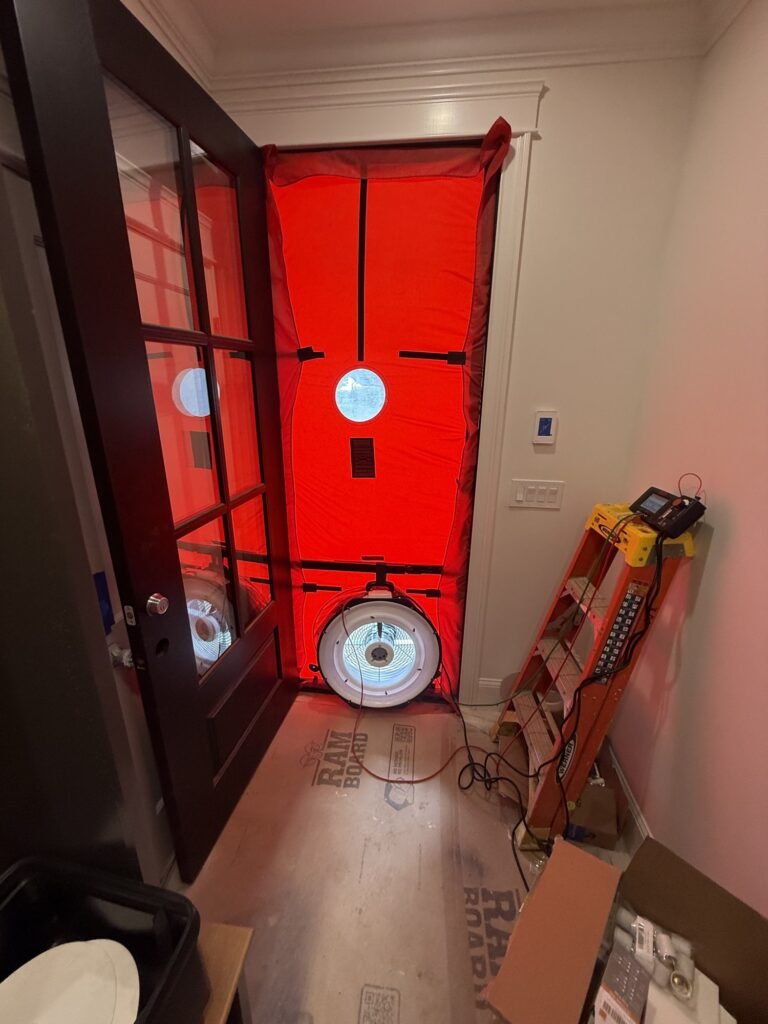
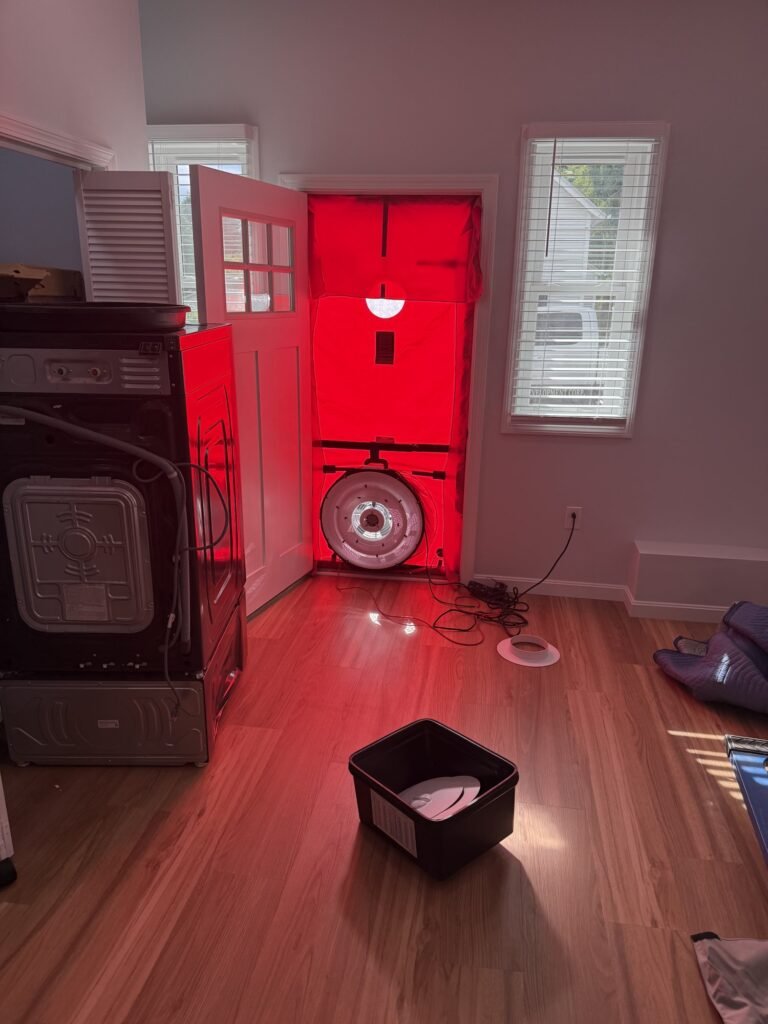
- Setup: we mount the fan in an exterior doorway and seal exhaust and ventilation openings only as the test protocol allows.
- Test: the house is depressurized to 50 Pascals and the leakage is measured.
- If it fails: we keep the fan running to find the leaks, your crew seals them, and we retest.
Our Somerville office at 519 Broadway is the nearest HEEC office to Lowell.
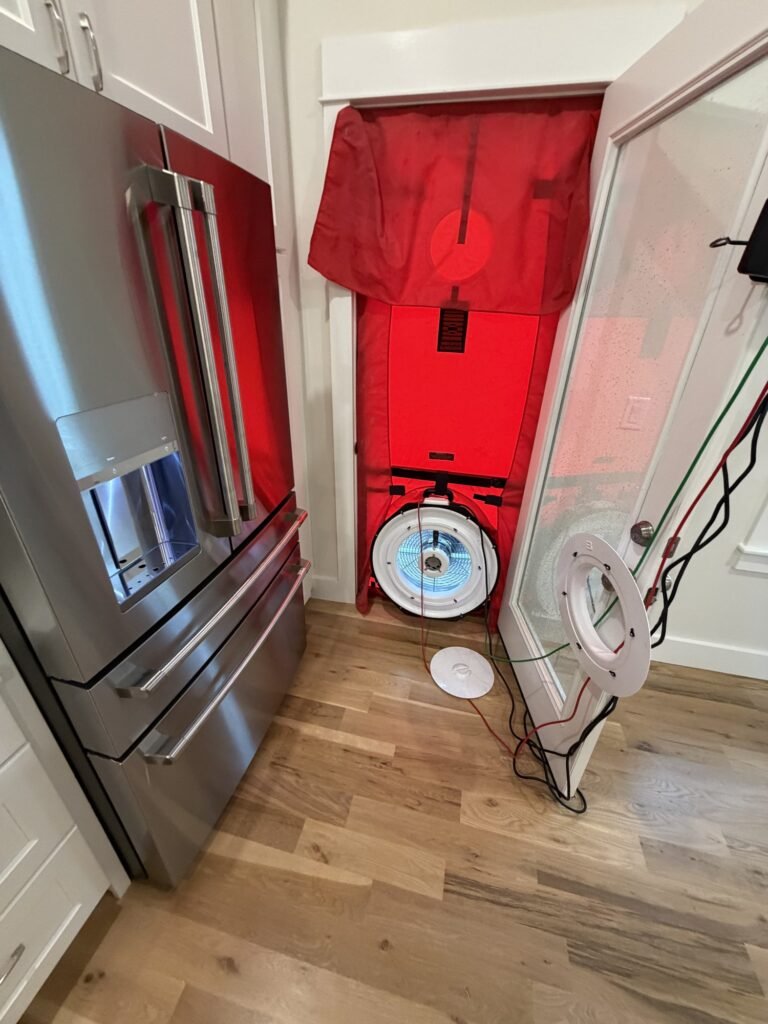
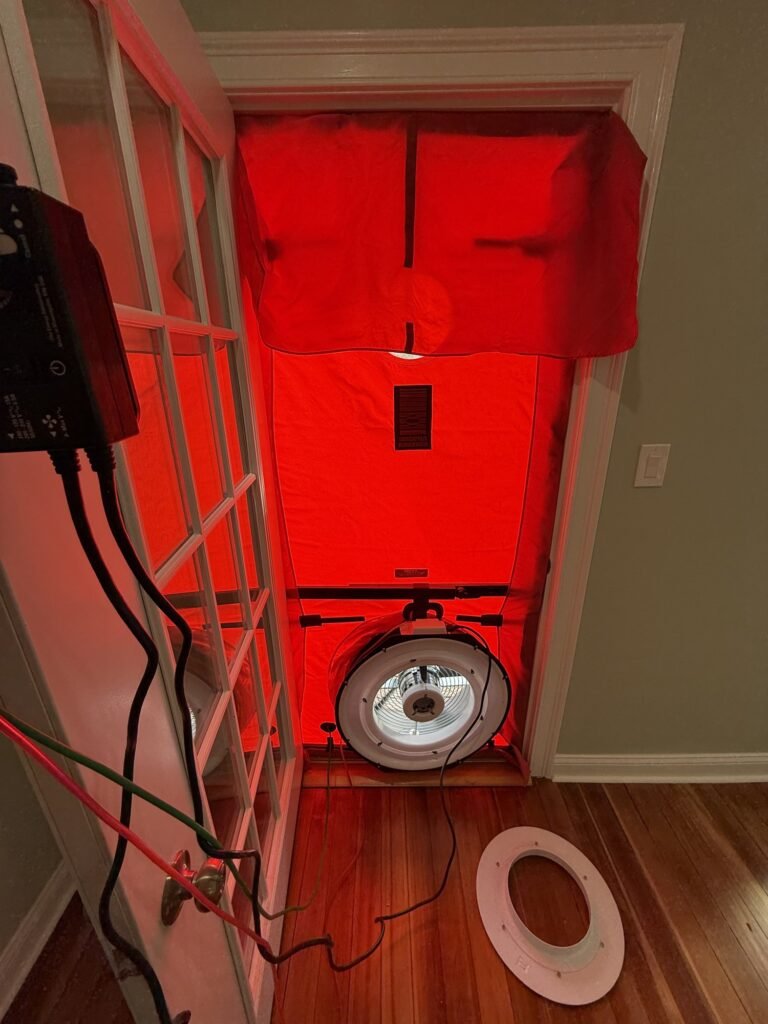
Real blower door tests by HEEC for Lowell projects
These are photos from Home Energy Efficiency Consultants blower door testing jobs in Massachusetts — the same equipment and setup our certified raters bring to Lowell homes.
FAQ About Blower Door Testing Lowell MA
Is a blower door test required by code?
Yes. Air-leakage testing is mandatory under R402.4.1.2 for new residential construction, verified with a blower door at 50 Pascals.
When in construction should the test be done?
A pre-drywall diagnostic test is ideal for catching leaks while they are easy to reach, followed by a final compliance test near completion.
Why does my house feel drafty and cold in winter?
Much of that is the stack effect - warm air leaking out up high draws cold outdoor air in through gaps down low, chilling floors and lower rooms. A blower door test pinpoints exactly where that air is entering so it can be sealed.
How tight is a Passive House?
PHI Passive House projects must test at 0.6 ACH50 or lower. Phius projects use a different limit: 0.06 CFM50 per square foot of building enclosure (0.08 for non-combustible buildings of 5+ stories), verified with a multi-point whole-building blower door test.
Do additions need a blower door test?
Many do, but additions under 1,000 square feet can be exempt from air-leakage testing under R502.3.1. We can confirm what your specific project requires.
How long does a blower door test take?
For a typical single-family home the test itself usually takes well under an hour once the fan is set up and the home is prepared.
How do I set up a final inspection with Lowell's building office?
Contact Lowell Development Services at 978-674-4144 or buildingpermits@lowellma.gov. The city's Online Permitting system has been listed as unavailable, so calling or emailing is the reliable route. Have the blower door report ready before the final.
Is Lowell on the Specialized (Opt-In) Code?
No. Lowell adopted the Stretch Code on January 1, 2011 and has not adopted the Specialized (Opt-In) Code. New homes need a blower door result of 3.0 ACH50 or lower at final.
Blower Door Test Requirements for Lowell Projects
Lowell is not on the Specialized Code list, so new homes follow the Massachusetts Stretch Code (225 CMR 22.00), adopted by 242 communities. Lowell adopted it effective January 1, 2011. The testing requirements below come from 225 CMR 22.00 and the 2021 IECC it amends.
| Requirement | Limit | Source |
|---|---|---|
| New home, prescriptive path | 3.0 ACH50 or lower | IECC 2021 R402.4.1.3 (Climate Zone 5, all of Massachusetts) |
| Maximum on any compliance path | 5.0 ACH50 or 0.28 CFM50 per sq ft of enclosure | IECC 2021 R402.4.1.2 |
| Attached homes and apartments tested unit by unit | 0.30 CFM50 per sq ft of unit enclosure (alternative) | IECC 2021 R402.4.1.2 exception |
| Mass Save ENERGY STAR tier | 1.5 ACH50 or lower | Mass Save new construction program |
| Passive House (PHI) | 0.6 ACH50 or lower | Passive House Institute |
| Passive House (Phius) | 0.06 CFM50 per sq ft of enclosure (0.08 for non-combustible 5+ stories) | Phius 2024 Certification Guidebook |
How the house is set up for the test
- Exterior windows and doors closed, with no sealing beyond normal weatherstripping
- Dampers closed but not taped, and interior doors open
- Exterior ventilation openings sealed, heating and cooling turned off, supply and return registers open
- Tested at 50 Pascals per ANSI/RESNET/ICC 380, ASTM E779 or ASTM E1827, with a signed report for the Lowell building department
Sources: 225 CMR 22.00 (2025 edition) and the 2021 IECC sections listed. Lowell is in Middlesex County, served from our Somerville (519 Broadway) office.
Blower Door Questions from Lowell Builders
What blower door number does a new home in Lowell need?
On the prescriptive path the 2021 IECC requires 3.0 ACH50 or lower in Massachusetts, and no home on any path may exceed 5.0 ACH50. Homes on the HERS path are tested the same way, and the result goes into the HERS model, so a tighter house earns a lower HERS score.
What is ACH50?
Air changes per hour at 50 Pascals: how many times the home's air volume leaks out each hour while a blower door holds the house at 50 Pa. ACH50 = CFM50 × 60 ÷ conditioned volume.
How are townhouses and apartments tested?
Each dwelling unit can be tested on its own and meet 0.30 CFM50 per square foot of the unit's enclosure, which counts walls, floor and ceiling shared with neighbors. Large buildings may also get a whole-building test.
What gets taped or closed during the test?
Windows and exterior doors are closed, dampers are closed but not sealed, and exterior ventilation openings such as bath fan and ERV/HRV terminations are sealed. Interior doors stay open and the heating and cooling system is off.
When should the blower door test happen?
The code test happens at the end of construction. We recommend a pre-drywall test once the air barrier is complete, when leaks are cheap to find and fix, so the final test is a formality.
How much does blower door testing cost in Lowell?
Pricing depends on the size of the building and the number of units. Send your plans or address and we will quote the test, or bundle it with your HERS rating and duct test in one visit.
Related: Duct leakage testing in Lowell · HERS rating in Lowell · Stretch Code help in Lowell
Get Started With Blower Door Testing Lowell MA
Book a certified blower door test and get a permit-ready air-tightness report. Call 617-501-6788.

Mass Save®-Listed HERS Rater
 U.S. DOE Efficient New Home
Trusted Partner — Verified
 ENERGY STAR®
Partner
 Phius Certified
Passive House Verifier
 ICC
Member★★★★★136 Google
Reviews
The Phius Certified Verifier logo is used under license from Phius.
Last updated · Home Energy Efficiency Consultants, RESNET-certified HERS raters
HERS Ratings Across Lowell and Nearby Communities
Home Energy Efficiency Consultants rates new homes, additions, and major renovations throughout Lowell — from Belvidere, Pawtucketville, and Centralville to The Acre and Highlands. Every Lowell project is filed with the City of Lowell Building Department, and we handle the energy model, blower door and duct leakage testing, and the compliance paperwork from start to finish.
We also serve the communities right around Lowell, including Chelmsford, Dracut, Tewksbury, Tyngsborough, and Billerica. Our Everett office at 371 Main St is the closest of our four Massachusetts locations — see our Everett office or call (617) 501-6788 to get a Lowell rating on the schedule.
More Massachusetts Towns We Serve
Certified HERS ratings, blower door testing and energy code compliance across all 351 Massachusetts cities and towns.