Moisture, Condensation and Mold in Tight New Homes in Massachusetts
New Massachusetts homes are built much tighter than older homes, so moisture from people, showers, cooking and new materials has nowhere to go unless the ventilation works. When an ERV or HRV is undersized, unbalanced or turned off, humidity climbs, windows sweat and mold can start. The EPA recommends keeping indoor humidity below 60%, ideally 30-50%. We find the cause with blower door, airflow and humidity testing.
Warning signs
Window condensation, musty smells, damp closets or corners, mold on cold exterior walls, or indoor humidity above 60% for days at a time.
Why Tight Houses Get Moisture Problems
- A family adds several pints of water vapor a day from breathing, showers and cooking.
- New construction releases moisture from framing, concrete and drywall for the first year.
- Tight walls (low ACH50) stop the old "natural" air leakage that used to dry houses out.
- If the ERV/HRV runs too low, is unbalanced, or is switched off, that moisture stays inside.
How an ERV Works
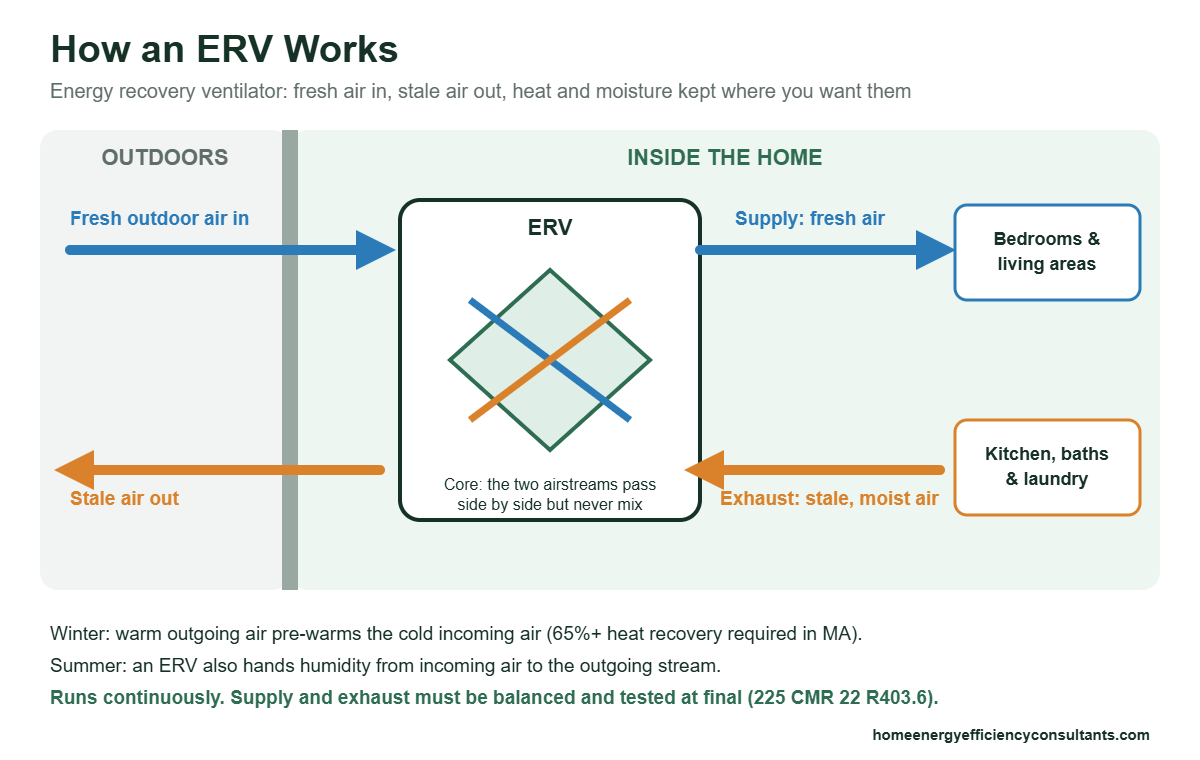
- Two fans run continuously: one brings fresh outdoor air in, the other pulls stale air out of kitchens, baths and laundry.
- Both airstreams pass through the core side by side but never mix.
- In winter the warm outgoing air pre-warms the cold incoming air, so you get fresh air without a big heating penalty (code requires 65%+ sensible recovery).
- In summer an ERV also moves some humidity from the incoming air to the outgoing stream. An HRV recovers heat only.
Choosing between them? See ERV vs. HRV.
Why Proper Balancing Is So Important
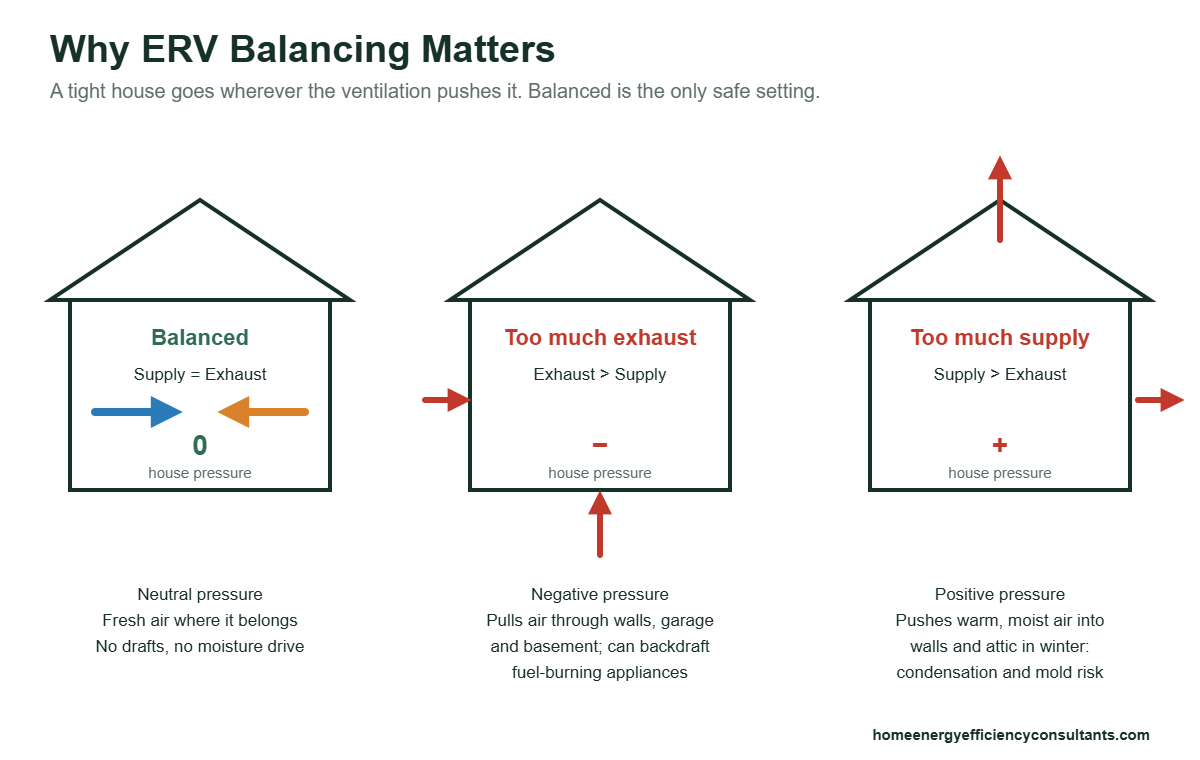
In a tight house, even a small mismatch between supply and exhaust changes the pressure of the whole home:
- Too much exhaust (negative pressure): the house pulls replacement air through walls, the garage and the basement, which can bring in dust, fumes and soil gases, and can backdraft fuel-burning appliances.
- Too much supply (positive pressure): warm, moist indoor air is pushed into wall and attic cavities in winter, where it can condense and grow mold.
- Wrong total airflow: too little leaves stale, humid air; too much wastes energy and dries the house out in winter.
We measure supply and exhaust with a calibrated flow hood or flow grid, adjust with your HVAC contractor until they match the design rate, and document it for the inspector. See ventilation testing and balancing.
What We Check
| Test | What it tells us |
|---|---|
| Blower door | How tight the house is, which sets the ventilation it needs |
| ERV/HRV airflow | Whether the system delivers the design rate and is balanced |
| Bath and kitchen exhaust | Whether fans meet minimum rates and vent outdoors |
| Humidity readings | Where and when RH runs high |
| Pressure checks | Whether the house runs positive or negative to outdoors |
Common Fixes
- Set the ERV/HRV to the correct continuous rate and balance it.
- Run bath fans during and after showers; use the range hood when cooking.
- Vent dryers and fans to the outdoors, not into attics.
- Kitchen hoods over 400 cfm need makeup air.
- Let the HVAC dehumidify in summer; size equipment with a Manual J so it is not oversized and short-cycling.
- Adding an ERV or HRV to an existing home? Mass Save offers a $500 instant discount on qualified units for retrofits (not new construction).
ERV or HRV for a humid house? See ERV vs. HRV in Massachusetts.
Get It Tested
We combine blower door testing, ventilation testing and balancing and humidity checks into one visit and tell you exactly what to adjust.
FAQ
Why does my new house have condensation on the windows?
Usually indoor humidity is too high because the ventilation is too low, unbalanced or turned off. Tight new homes depend on the ERV or HRV to remove moisture.
What humidity should my house be?
The EPA recommends keeping indoor relative humidity below 60%, ideally between 30% and 50%.
Can an ERV cause mold?
An ERV that is unbalanced or set too low can let humidity build up. A correctly sized and balanced system helps prevent it.
Should I turn off my ERV in winter?
No. Whole-house ventilation in new Massachusetts homes is designed to run continuously. Turning it off lets moisture and pollutants build up.
Do you test existing homes for moisture problems?
Yes. We test airflow, pressure and humidity in new and existing homes.
Town-by-Town Permit Checklists
Local building department details, checked on each town's own website:
Sources: EPA: A Brief Guide to Mold, Moisture and Your Home · 225 CMR 22 (Stretch/Specialized residential) · Mass Save HRV/ERV instant discount. Code text current as of October 2026; DOER has proposed updates to the Stretch and Specialized codes, so confirm before you file.
Related: Stretch code report for permitting · What triggers a HERS rating · REScheck and COMcheck · Phius verification
Moisture Problem in a New Home?
Send your plans today. Most projected HERS reports are ready in about one business day after the quote is accepted.

Mass Save®-Listed HERS Rater
 U.S. DOE Efficient New Home
Trusted Partner — Verified
 ENERGY STAR®
Partner
 Phius Certified
Passive House Verifier
 ICC
ICCMember★★★★★136 Google
Reviews
The Phius Certified Verifier logo is used under license from Phius.